

 Tiếng Việt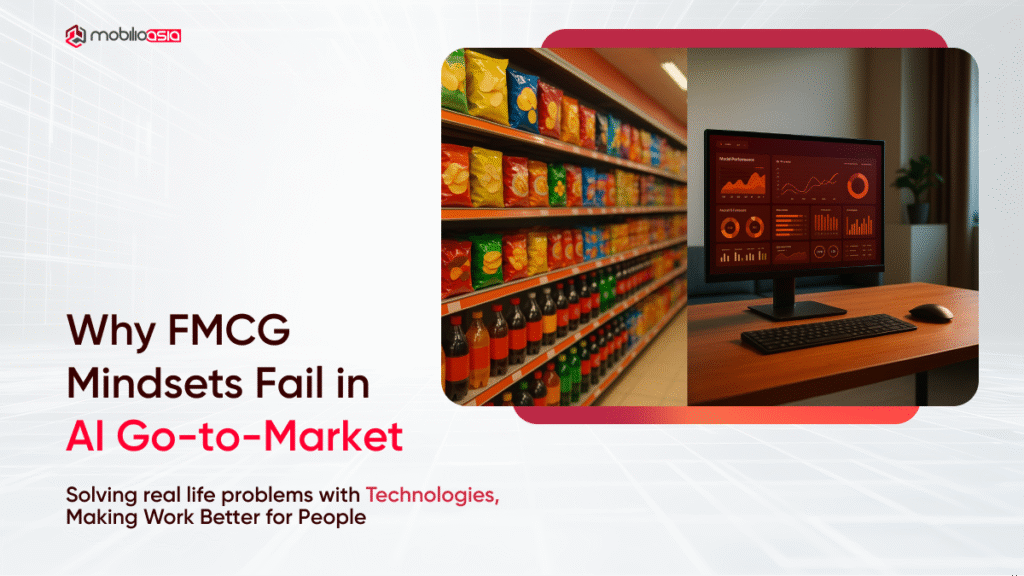
Marketing AI Products: Why FMCG Thinking Is Holding Tech Companies Back
A strategic perspective from Mobilio for Go-to-Market teams, Product Marketers, and Business Decision Makers in AI.
Executive Summary
In the current wave of AI innovation, many products with strong technological potential still fail to penetrate the market. The problem often doesn’t lie in the features, but in the go-to-market approach. Too many startups and tech firms are trying to sell AI like a fast-moving consumer good (FMCG): chasing virality, investing heavily in traditional funnel ads, while ignoring strategic advisory steps critical for enterprise clients.
From our experience delivering 20+ AI and data projects across Vietnam, Singapore, and Malaysia, Mobilio has learned this: AI solutions cannot be marketed like FMCG products. Instead, they require a trust ecosystem, built through data, deep content, and cross-functional alignment.
I. FMCG Thinking Doesn’t Fit the AI Sales Cycle
AI solutions are often highly technical, requiring integration with existing systems and internal change management. This results in a longer sales cycle with multiple evaluation stages and internal validation checkpoints. Emotional, fast-buy B2C or FMCG models, centered on visual branding and impulse decisions, rarely create lasting B2B conversions.
According to BCG X (2023):
“On average, the AI solution buying journey in mid to large enterprises spans 4–7 months, with at least 3 demos, 2 ROI validation rounds, and a pilot before a contract is signed.” (Source: BCG X: How to Sell AI Like a Strategy, Not a Tool)
Yet, many young AI companies still adopt short-term campaigns like “generate curiosity → drive signups → retarget in 3 days.” This might work for low-commitment SaaS, but it’s misaligned for AI solutions that require cross-departmental buy-in.
II. AI Buyers Want Logic – Not Inspiration
When selling to CEOs, CTOs, CFOs, or Heads of Operations, marketing is no longer about “telling a great story” but presenting a solid argument.
According to Gartner (2022):
“67% of B2B buying groups require quantified ROI evidence before committing to a new AI solution.” (Source: Gartner: Tech Buying Trends for the New B2B Buyer)
Effective marketing content isn’t about flashy visuals or clever slogans. Instead, it includes:
- Pre and post implementation ROI reports
- System integration roadmaps with clear timelines
- Simulated use cases tailored to the buyer’s real-world environment
- Measurable, pilot-based testing
Case in Vietnam: An AI company promoting a customer service chatbot failed within 4 months. The campaign used humorous images and viral slogans, typical consumer-style marketing. However, the Operations team rejected the product due to lack of load testing documentation, cost-saving models, and integration support.
III. From Funnel Tactics to a Trust-Based Content Ecosystem
At Mobilio, we experimented with the traditional marketing funnel (awareness → lead → retarget → convert). But B2B AI buyers didn’t convert after 3–5 touches, they converted after 30–60 days of consistent, substantive content exposure.
Instead of a funnel, we built a decision-oriented trust ecosystem:
- Industry-specific use cases with simulated customer scenarios
- Detailed demo videos tailored to real business contexts
- Role-based nurturing:
The result? Fewer responses, but far higher quality. Prospects asked informed questions, made faster decisions, and often shortened the negotiation cycle from three meetings to just one or two.
IV. Thought Leadership: A Knowledge System, Not Just Content
AI buyers aren’t looking for hype. They’re looking for people who understand their problems, have solved them before, and can offer a grounded roadmap.
That’s why Mobilio’s thought leadership strategy includes:
- LinkedIn Series “AI for Decision Makers”, each post tailored to a role (CFO, CTO, CMO), covering technical, financial, and UX perspectives.
- Private sector briefings, no product pitches, only real case studies of success and failure.
- Specialized whitepapers, e.g.: “Reducing KPI Reporting from 3 Days to 45 Minutes: What It Takes Beyond the Tech”
Every asset is grounded in business context: real data, org structures, measurable KPIs, and unexpected real-world hurdles.
V. New Mindset: Don’t Start With AI. Start With the Business Problem.
We’ve chosen to go against the “tech-first” trend. At Mobilio, every campaign begins with three questions:
- What is the real business problem we’re solving?
- Which systems and stakeholders are involved?
- Without AI, how is the problem currently handled?
Only after answering these do we introduce AI, as a tool to solve reality, not to impress.
Conclusion: AI Marketing Doesn’t Need to Be Viral. It Needs to Be Understood.
In enterprise environments, valuable “virality” doesn’t come from social reach. It comes from your message being forwarded internally to decision-makers.
If you’re building an AI product and unsure where to begin, don’t think like an FMCG seller. Think like a transformation advisor.
About Mobilio
Mobilio is a trusted tech partner across Vietnam, Singapore, and Malaysia, delivering enterprise application development, data solutions, and AI services.
Near future, we’re launching Syncalytics, an AI-powered platform for data analytics and business decision optimization.
Connect with us if you’re seeking a go-to-market strategy for AI that prioritizes execution, transformation, and lasting trust, not hype.
#MarketingAI #B2BMarketing #AIForBusiness #Mobilio #GoToMarket #Syncalytics #TechStrategy #ThoughtLeadership #CustomerDecisionJourney

Pingback: Strategic Software Outsourcing Vietnam: Cost, Talent 2026
Pingback: Application Development Outsource: 9 Proven Ways to Win