

 Tiếng Việt
In Singapore and across APAC, the demand for cost-efficient, high-quality engineering talent continues to accelerate. As digital transformation initiatives intensify and the competition for software talent tightens, businesses are reassessing where and how they build their development capacity. This shift has brought software outsourcing Vietnam into sharper focus positioning the country as one of Asia’s fastest-growing technology delivery hubs.
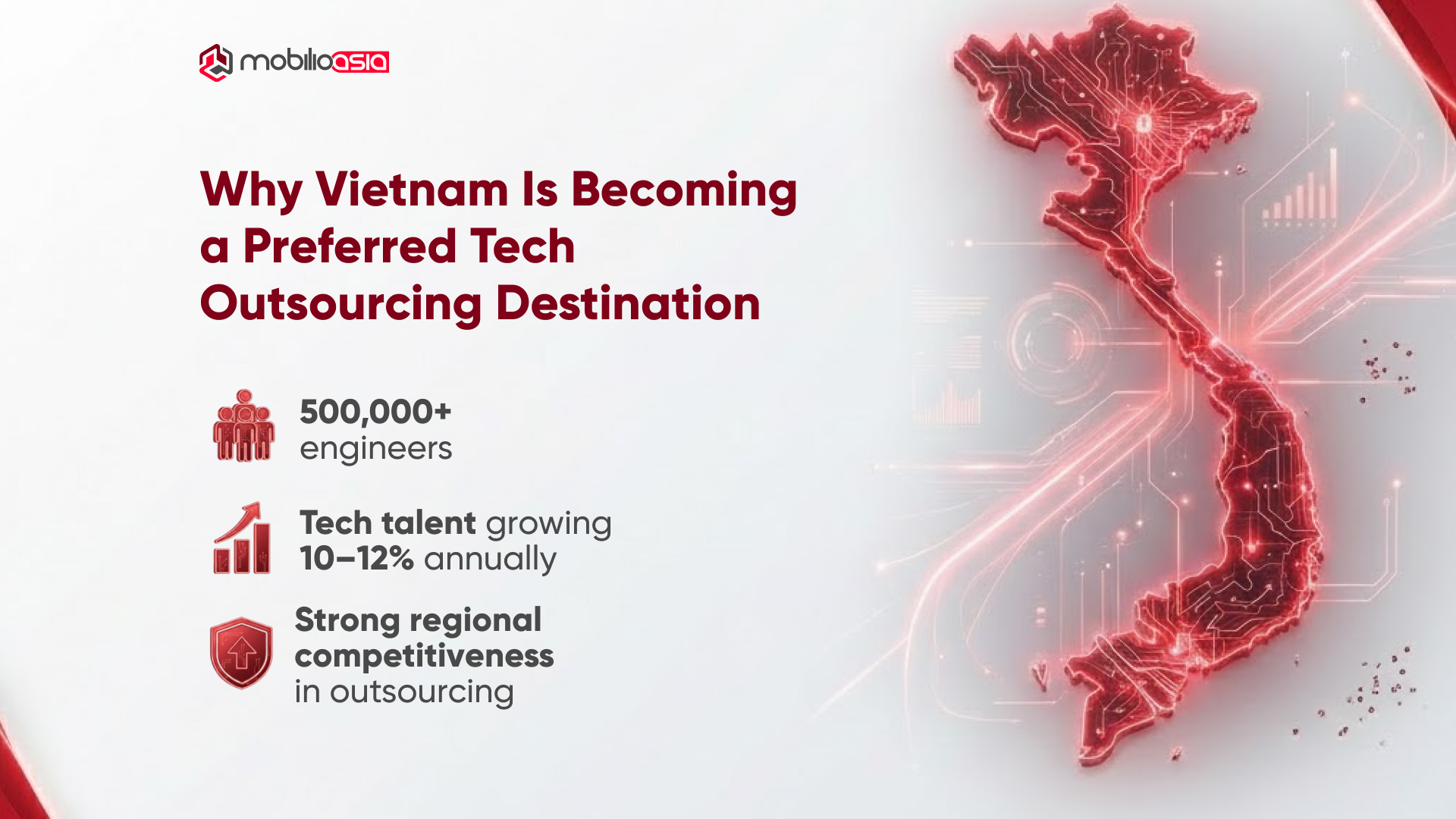
Over the past decade, Vietnam has emerged as a credible and increasingly strategic alternative to traditional outsourcing destinations such as India and China. According to Gartner analysis on global IT outsourcing locations and the Tholons Global Innovation Index, Vietnam consistently ranks among the top IT outsourcing locations globally, supported by a rapidly expanding engineering workforce and competitive cost structures.¹ ² Its talent pipeline now exceeding 500,000 ICT professionals continues to grow at double-digit rates, strengthening the country’s position as a scalable offshore development base.
For Singapore companies, the appeal is pragmatic. Rising hiring costs, capacity constraints, and a sustained talent shortage have made offshore software development in Vietnam one of the most viable ways to ensure continuity and speed in digital delivery. The country offers a rare combination: cost efficiency, technical capability, geographical proximity, and increasingly mature delivery discipline.
As organizations across ASEAN look ahead to 2026, Vietnam presents what many leaders describe as the strongest balance of cost, capability, and delivery scalability. This reinforces a clear search intent trend: companies are not merely exploring outsourcing as a cost lever, but as a strategic extension of their engineering capacity, making Vietnam a core part of their long-term digital plans.
Vietnam’s Strategic Advantages for Software Outsourcing Vietnam
1. Cost Efficiency With Enterprise-Level Quality
For Singapore enterprises, cost efficiency is no longer about finding the “cheapest” destination, it is about identifying markets where high-caliber engineering talent is available at a sustainable cost. Vietnam delivers precisely this balance. Industry benchmarks on offshore rates indicate that software development in Vietnam is significantly more cost-effective than in major Asian and Western hubs, with typical hourly rates in the $18–35 range for experienced engineers, versus substantially higher brackets in countries like China, Eastern Europe, or the US.¹ ²
As highlighted in “Offshore Software Development Rates By Country 2025”, Vietnam is consistently positioned as a low-cost, high-quality software outsourcing destination, often 30–40% more affordable than China while maintaining competitive quality standards.¹ This differential produces tangible ROI for organizations executing long-term digital transformation programs, where the ability to maintain velocity without inflating operational costs is a decisive advantage.
As a result, Vietnam has shifted from being a cost-saving option to becoming a strategic component of regional engineering capacity planning especially for firms exploring offshore software development in Vietnam as a scalable delivery model.
2. Deep Engineering Talent Pool (Growing 10–12% YoY)
Vietnam’s technology workforce continues to expand, supported by a dense network of universities and private training providers that supply engineers proficient in mobile development, web technologies, cloud architecture, and emerging fields such as AI and data engineering. Market studies such as the Vietnam IT Market Report 2023 – Vietnam Tech Talents Report (TopDev) point to a rapidly growing pool of IT professionals and rising demand for engineering roles across the country.³
For companies evaluating a Vietnam software development company, what often stands out is the speed and discipline with which teams execute. Regional assessments from TopDev and other market reports note that Vietnam app developers and web engineers tend to deliver consistently across sprints, with rapid iteration cycles attributes highly valued in Agile environments common across Singapore and ASEAN enterprises.³
3. Strong English Proficiency & Cultural Fit
Vietnam’s workforce exhibits increasing English proficiency and strong cultural compatibility with Singapore’s professional norms. Teams are accustomed to Agile/Scrum workflows, structured reporting, and cross-functional collaboration factors that reduce coordination overhead and accelerate delivery.
The work culture alignment is further reinforced by Vietnam’s growing exposure to international clients in sectors such as fintech, logistics, healthcare, and e-commerce. This allows teams to assimilate business logic rapidly while maintaining the communication clarity needed for distributed development.
4. Increasing Government Support for IT & Innovation
Vietnam’s government continues to expand national initiatives designed to strengthen the country’s digital economy. Policy frameworks under the National Digital Transformation Program through 2025, with orientation to 2030 prioritize digital skills development, digital government, and the acceleration of Industry 4.0 capabilities.⁴ A series of reports from the Ministry of Planning and Investment and the Ministry of Information and Communications reinforce digital transformation as a core pillar of Vietnam’s long-term growth strategy.⁴
In parallel, major cities including Ho Chi Minh City, Hanoi, and Da Nang are rapidly expanding IT parks, R&D zones, and university–industry partnerships. This ecosystem is creating favorable conditions for outsourcing partners to scale teams and invest in long-term engineering capabilities.
5. Stability & Lower Delivery Risk Compared to Other Markets
In an environment where delivery risk is a central concern for CIOs and technology leaders, Vietnam offers a stable and predictable operating climate. Labor costs remain steady, political conditions are comparatively stable, and workforce turnover rates are lower than in several traditional outsourcing markets.
For companies building multi-year digital roadmaps, these factors translate into reduced operational uncertainty and more consistent performance making Vietnam a long-term, reliable destination for offshore development and regional engineering capacity.
What Types of Projects Are Commonly Outsourced Through Software Outsourcing Vietnam?
As Vietnam strengthens its position as a regional engineering hub, Singapore companies are increasingly diversifying the types of projects they offshore ranging from mobile applications to complex enterprise platforms and long-term dedicated teams. The spectrum of work reflects both the maturity of Vietnam’s talent pool and the operational reliability of its outsourcing ecosystem.
1. Mobile App Development
Mobile development remains one of the most active outsourcing categories, particularly for iOS, Android, Flutter, and React Native applications. SMEs and mid-sized enterprises in Singapore often accelerate product delivery by partnering with Vietnamese teams due to competitive cost structures and rapid execution cycles.
Independent assessments such as Why Choose Vietnam for App Development Outsourcing: Benefits and Expert Insights highlight the country’s combination of engineering depth, English proficiency, and fast iteration speed key drivers behind the rise of mobile app development Vietnam as a preferred outsourcing model for APAC companies.¹
For organizations seeking to validate concepts quickly or scale mobile features without expanding internal headcount, Vietnam provides an attractive extension of their product engineering capability.
2. Web & Platform Development
Vietnam is increasingly recognized as a reliable destination for complex platform development including SaaS products, booking engines, multi-vendor marketplaces, and custom ERP/CRM systems.
Reports such as Vietnam Has Rapidly Emerged as a Premier Destination for Web Development Outsourcing note that Vietnamese engineering teams demonstrate strong competencies in modern frameworks, cloud-native architectures, and API-driven platform design.²
For Singapore enterprises evaluating a web development company Vietnam, the value proposition is clear: the ability to build scalable digital platforms with predictable delivery cadence, strong QA discipline, and competitive total cost of ownership.
3. Full Software Product Development (End-to-End Delivery)
Beyond discrete functions, Vietnam is now a viable location for end-to-end software product development. This model covers the full lifecycle from product discovery and UX/UI design to engineering, quality assurance, and cloud deployment.
Market analyses such as Vietnam’s IT Outsourcing Industry Is Growing at a Pace Few Other Countries Can Match underline that Vietnam’s engineering ecosystem is maturing beyond “developer-only outsourcing,” evolving into full-cycle product development capability.³
This makes Vietnam particularly appealing for Singapore firms building new digital ventures or expanding existing product lines without committing to extensive in-house R&D teams.
4. Dedicated Developer Teams for Scaling
For many Singapore technology companies, the most strategic outsourcing model is the establishment of long-term, dedicated development teams. These teams operate as an extension of the client’s engineering organization aligned on tools, workflows, and delivery objectives.
Industry commentary such as Why Outsourcing to Vietnam Is a Smart Choice: Affordable, Skilled Workforce, High-Quality Tech Solutions highlights that Vietnam offers one of the region’s most stable talent markets, with lower attrition and higher role continuity than competing offshore destinations.⁴
For enterprises and scaling startups, the ability to hire developer team Vietnam unlocks sustainable velocity without the overhead burden of local recruitment and retention.
Cost of Software Outsourcing Vietnam (2026 Benchmark)

1. Salary & Rate Comparison: Vietnam vs Singapore vs India
When companies benchmark the costs of building development capacity, Vietnam continues to offer one of the most cost-efficient engineering markets in Asia. For instance, recent rate surveys show that Vietnamese developers typically charge between US $20–50 per hour, depending on experience and specialization.¹ ² A more detailed breakdown from 2025 lists junior-level rates around US $18–22/hr, mid-level at US $25–28/hr, and senior engineers at about US $30–35/hr.³
By contrast, many Singapore-based teams have labor costs equivalent to monthly salaries of US $4,500–7,000, according to regional outsourcing reports meaning that outsourcing to Vietnam can reduce hourly labour expenditure by more than 60%.⁴ This gap becomes even more pronounced when adjusting for benefits, overheads, and local taxes in Singapore, making offshore software development Vietnam a highly attractive option for enterprises targeting both cost control and engineering velocity.
Depending on project size and team composition, this often translates into significant savings on monthly or annual budgets, especially for long-term engagements or large feature backlogs.
2. Cost by Engagement Model
Vietnam’s outsourcing ecosystem accommodates multiple engagement models, each with distinct cost and operational trade-offs:
- Dedicated Team model: Clients retain a stable team of developers (frontend, backend, full-stack, QA, PM, etc.) on a monthly retainer. This model offers predictable monthly fees, making budgeting and long-term roadmaps more reliable.
- Project-based (Fixed Price): Well suited for MVPs or mid-sized projects, where scope is clearly defined up front. For a typical mid-size SaaS or web platform, outsourcing firms report full-project budgets in the US $10,000–200,000 range, depending on complexity.¹
- Time & Materials (T&M): Favoured for projects with evolving requirements. Clients pay per actual hours worked beneficial for agile teams needing flexibility, but requiring strong governance and scope control to avoid cost overruns.
This flexibility in engagement models coupled with competitive labor rates is part of why many Singapore and ASEAN companies consider Vietnam software development company partnerships when scaling rapidly or exploring new product lines.
3. Hidden Costs to Consider
Outsourcing to Vietnam is cost-effective, but not cost-free. To maintain delivery quality and avoid unexpected expenses, companies should account for several “hidden” costs:
- Knowledge transfer & onboarding overhead initial ramp-up when integrating remote teams can consume 10–20% extra time in the first sprints. Without clear documentation and alignment, this may extend timelines and inflate budgets.
- Communication overhead & timezone coordination although Vietnam shares favourable timezone overlap with Singapore, language or workflow misalignments can still lead to inefficiencies if the team structure or processes are unclear.
- Delivery assurance & quality control quality standards, testing, and code reviews need to be enforced. If not managed well, rework may erode the cost advantage.
- Scalability overhead as teams expand, administrative, HR, compliance, and project management costs may rise; these should be budgeted alongside base developer costs, especially under a Dedicated Team model.
Thus, while the headline numbers for cost of software outsourcing Vietnam are compelling, smart buyers will factor in operational overhead, project governance and quality assurance to realize true long-term value.
However, cost advantage alone is not enough. Successful software outsourcing Vietnam increasingly depends on how well teams understand product strategy and go-to-market dynamics especially for AI-driven products.
-> Read more Marketing AI Products: Why FMCG Thinking Is Holding Tech Companies Back
Software Outsourcing Vietnam vs. Other Destinations (India, China, Eastern Europe)
As companies assess where to locate their engineering capacity, it is increasingly clear that Vietnam often delivers a stronger value proposition than traditional outsourcing hubs. Here’s how Vietnam stacks up and why many Singaporean and ASEAN firms are pivoting accordingly.
- Speed vs. Price: Vietnam frequently offers the fastest iteration cycles among offshore markets. Firms such as IT outsourcing in Vietnam: Benefits vs Complete Guide note that Vietnamese teams combine competitive pricing with swift delivery making them ideal for agile development cycles and rapid product iterations.⁴
- Quality vs. Communication: Despite its lower cost, many Singapore companies rate Vietnamese developers highly for quality and communication. According to Outsourcing Software Development: Vietnam vs. India – Benefits of Vietnam, Vietnam’s growing engineering workforce, combined with improving English proficiency and disciplined delivery practices, results in a balance of craftsmanship and clarity.⁷
- Talent Scalability vs. Eastern Europe Cost: Compared with Eastern Europe, Vietnam often provides lower labour rates while offering access to a rapidly expanding pool of developers making scaling easier and more cost-efficient. A comparative analysis by Software Developers Hiring Costs: Vietnam, India, and Eastern Europe shows that for many project types, Vietnam provides competitive hourly rates with acceptable quality trade-offs.¹⁰
- Lower Attrition Rate Compared to India: Because Vietnam’s IT outsourcing industry is relatively newer and growing, many firms report lower turnover rates than in saturated markets like India translating to better team continuity and less overhead in hiring/training replacements. As discussed in the same Vietnam–India outsourcing comparison article, this stability makes Vietnam a more reliable long-term partner.⁷
Overall, for enterprises seeking a balance of cost, speed, quality, and scalability, Vietnam emerges as a compelling alternative to India, China, or Eastern Europe particularly for projects that require agility or long-term team stability.
In 2026, Vietnam’s outsourcing advantage is no longer limited to engineering capacity. Many software outsourcing vietnam teams now integrate AI-powered analytics to support faster, data-driven product and business decisions.
-> Read more AI-powered Analytics: The Strategic Lever in an Uncertain Market
How to Choose the Right Vietnam Software Development Company for Software Outsourcing Vietnam
Selecting the right vendor is as critical as choosing the right destination. For a Vietnam software development company to truly function as an extension of your engineering org, firms should evaluate across four key dimensions:
1. Evaluate Technical Depth
- Domain expertise: Ensure the vendor has proven experience in your domain (Fintech, eCommerce, Healthcare, Logistics, etc.). This reduces ramp-up time and mitigates business-logic risk.
- Code quality benchmarks: Look for firms that enforce coding standards, maintain automated tests, and follow best practices. Vendors with strong technical depth are more likely to deliver maintainable, scalable code than those focused solely on “cheap labour.”
2. Delivery Model & Transparency
Transparency in process is critical. The right vendor must provide clear reporting, sprint planning, and QA processes ideally with tools that allow you to monitor backlog, velocity, and quality metrics. This gives you assurance that the team is functioning like an in-house unit, not a distant contractor.
3. Communication & Cultural Alignment
Strong English proficiency and compatible working culture (time-zone overlap, overlapping work hours, shared project rhythms) help reduce friction. Cultural alignment is especially important for Agile workflows and for bridging the subtle expectations teams often have when collaborating across borders.
4. Security, Compliance & IP Protection
For long-term projects especially involving sensitive data or regulated industries vendors should support NDAs, ISO/IEC certifications, and enforce cloud security & compliance practices. This helps protect your intellectual property and ensures that your security posture meets enterprise standards.
In sum, a good vendor is not just a low-cost execution arm it becomes a strategic partner that aligns with your roadmap, quality expectations, and operational discipline.
Case Examples: Why Singapore Companies Choose Software Outsourcing Vietnam
Here are a few archetypal scenarios drawn from real-world patterns illustrating why companies routinely choose Vietnam for outsourcing:
- A startup scaling a mobile app: A Singapore-based early-stage startup needed to push new features fast without inflating burn rate. By engaging a Vietnamese dedicated team, they shipped mobile releases weekly, reduced overhead, and kept runway alive longer.
- An enterprise modernizing legacy systems: A mid-size enterprise migrated its monolithic backend to microservices using a hybrid Singapore–Vietnam delivery model. The vendor handled new modules, tests, and deployment while the Singapore office maintained oversight delivering higher velocity at ~40% lower cost.
- An SME launching a new digital product: For a custom SaaS product, the company engaged a Vietnamese vendor; development cost was ~40% lower than building locally, allowing them to reallocate savings into marketing and US/ASEAN expansion.
Such examples show why many firms consider a long-term partnership with Vietnamese development teams not simply a one-off outsourcing deal. When executed wisely, outsourcing to Vietnam becomes a strategic lever for growth, agility, and cost-efficient innovation.
As Southeast Asia remains a mobile-first market, many global companies choose Vietnam-based teams to build and scale mobile-first digital products efficiently.
-> Read more Mobile-First: The Strategic Imperative for Digital Products in a Mobile-Driven Market
Predictions for 2026: What’s Next for Software Outsourcing Vietnam?
As global demand for digital services accelerates, the outsourcing industry is evolving rapidly and Vietnam is well positioned to ride the next wave. Here’s how trends are likely to shape the market through 2026.
- AI-enabled development workflows: The adoption of artificial intelligence, machine learning, and automation across software delivery pipelines is transforming how teams work. According to industry overviews such as 12 Key IT Outsourcing Trends 2025, outsourcing providers are increasingly expected to offer AI/ML, automation, and cloud-native services making software outsourcing Vietnam not just about cost, but about access to advanced engineering capabilities.⁹
- Expansion of cloud, DevOps, and cybersecurity talent: As companies shift to cloud-first architecture and prioritize security and reliability, the need for DevOps, cloud engineers, and cybersecurity specialists will rise. Reports tracking market growth indicate that Vietnam’s outsourcing sector is adapting accordingly building talent capacity beyond “basic development” into full-stack, cloud-native and security-aware services. Saigon Technology+2Dirox+2
- Vietnam becoming a top 5 global outsourcing hub: According to a 2025 market analysis, Vietnam’s IT outsourcing revenues have shown strong growth, with the country poised to nearly double from its 2024 valuation by 2028. Dirox+2Vietnam+ (VietnamPlus)+2 Given this trajectory, it is realistic to project that Vietnam may join the ranks of the world’s top outsourcing destinations by 2026 offering a rare balance of cost-effectiveness, engineering talent depth, and regional proximity to ASEAN decision-makers.
Taken together, these trends suggest that Vietnam will not only sustain its competitive edge — but increasingly compete on strategic value: the ability to deliver cloud-native, AI-powered, scalable solutions with enterprise-grade standards. For businesses in Singapore and across Southeast Asia, this means outsourcing to Vietnam will likely evolve from a cost lever to a strategic engineering partnership.
Conclusion: Why Software Outsourcing Vietnam Is a Strategic Choice for APAC Enterprises
Vietnam’s value proposition remains compelling: a blend of cost-efficiency, deep engineering capability, and scalability increasingly enhanced by growth in cloud, AI, DevOps, and cybersecurity talent. For Singapore and ASEAN companies seeking to innovate quickly, scale reliably, and control cost, Vietnam offers a uniquely balanced outsourcing destination.
If you’re evaluating potential partners, consider starting with a pilot sprint: engage a small, focused team from a reliable Vietnam software development company, define clear deliverables, measure velocity and quality, then scale based on results. This approach allows you to test both technical delivery and cultural/communication alignment before committing to large-scale projects.
In short: with the right partner and the right engagement model, Vietnam stands ready not just to meet but to exceed the outsourcing needs of the region in 2026 and beyond.
Build scalable web and mobile applications with optimized performance and cost efficiency.

Pingback: 7 dấu hiệu chuyển sang phát triển phần mềm theo yêu cầu
Pingback: Outsourcing App Development: 9 Proven Steps to Launch Fast
Pingback: 7 Proven Ways to Win Website Development Outsourcing 2026