

 Tiếng Việt
Qualitative Research is one of the most effective approaches for understanding meaning in human behavior what people think, how they feel, and why they act the way they do. For many beginners, the first obstacle is volume: audio recordings, transcripts running hundreds of pages, field notes, and secondary documents.
A key reminder: the challenge isn’t “too much data.” In Qualitative Research, the real challenge is turning rich, messy data into defensible interpretation insights you can justify in a thesis defense or publication.
As Creswell & Creswell (2018) and Patton (2015) emphasize, qualitative work is fundamentally about interpreting meaning: what people think, how they feel, and what drives behavior.
Qualitative insight is also a key foundation in many Mixed Methods Research designs, especially when researchers need both measurable outcomes and human explanations.
This guide gives you a structured, practical roadmap:
-
What Qualitative Research is (and when to use it)
-
Four core qualitative data collection methods
-
A thesis-defensible academic workflow
-
How NVivo improves transparency, rigor, and speed
What Is Qualitative Research
Qualitative Research explores and interprets the meanings individuals or groups assign to a social or human problem. It focuses less on measurement and more on how people make sense of their world—through language, experience, and context.
A widely used definition appears in Creswell & Creswell (2018).
Key characteristics of Qualitative Research
-
Depth over measurement (understand meaning, not estimate frequency)
-
Context matters (social/cultural settings shape interpretation)
-
Meaning-rich data (text, audio/video, images, field notes, documents)
-
Interpretive, systematic analysis (coding → categories → themes → interpretation)
When Should You Use Qualitative Research?
Use Qualitative Research when your goal is explanation, meaning, mechanisms, or context—especially when the phenomenon is complex or under-studied.
Ideal situations
-
You need “why” or “how” answers
-
You’re exploring a new phenomenon
-
You’re studying emotion, motivation, identity
-
You’re building early theory or a conceptual model (often before quant)
This is especially common in Mixed Methods Research when researchers start exploratory and then test at scale.
4 Common Qualitative Data Collection Methods
Strong Qualitative Research does not collect everything. It selects methods that match the research question and the evidence required.

1. In-depth interviews
One-to-one conversations (semi-structured or unstructured) to elicit experience, meaning, and reasoning.
2. Focus groups
Guided group discussion (often 6–10 participants) to uncover norms, agreement/disagreement, and social dynamics.
3. Observation
Watching behavior in natural settings (classrooms, clinics, workplaces) supported by field notes.
4. Document analysis
Analyzing secondary sources (reports, policies, institutional records, social media, news, archives) to triangulate claims and trace narratives.
If you want deeper method guidance, see Patton (2015) and Merriam & Tisdell (2016).
Internal related read: Qualitative analysis techniques
Academic-Standard Qualitative Research Workflow
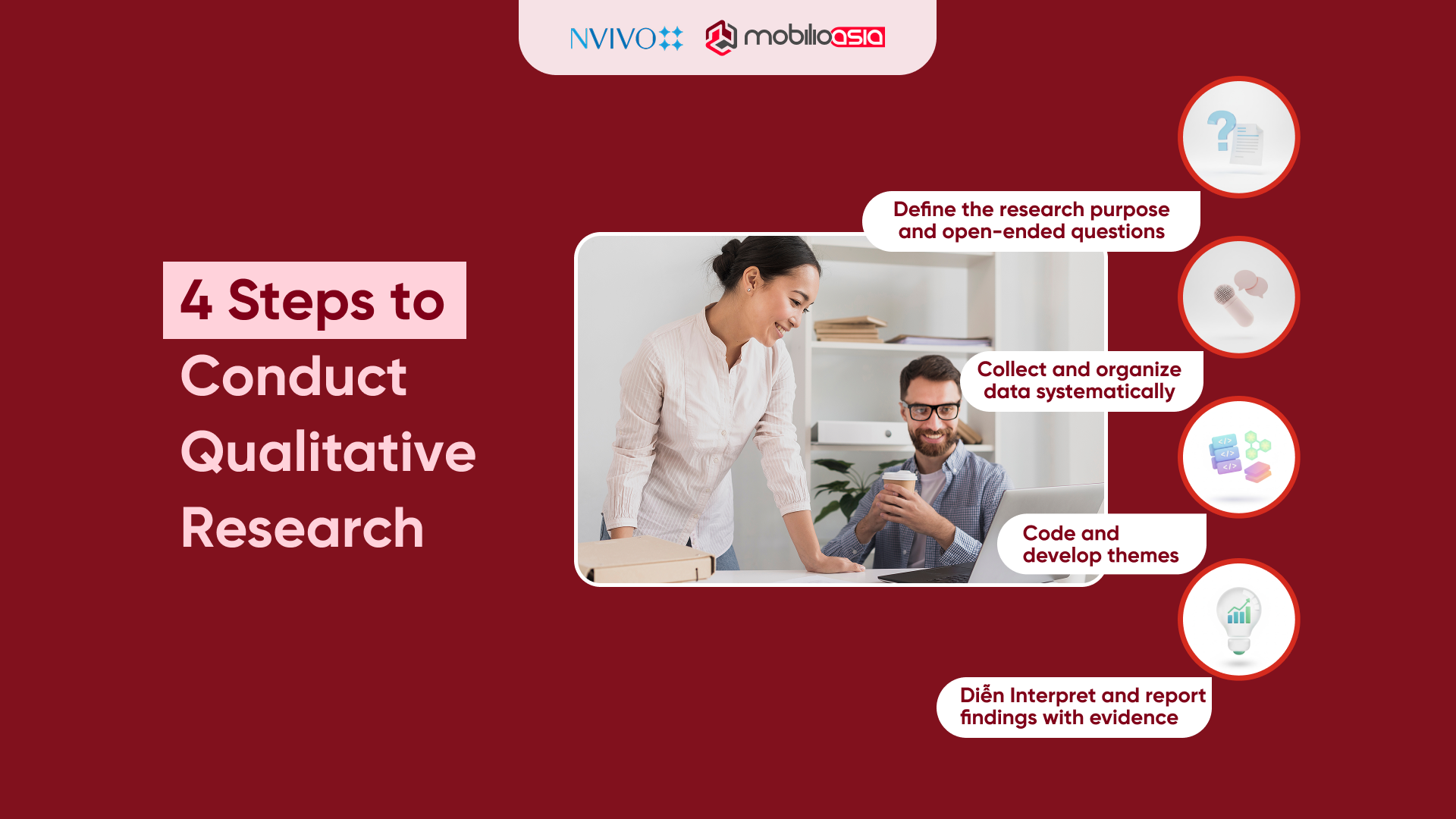
Step 1: Define objectives and open-ended research questions
Your questions should invite interpretation, not measurement.
Example:
“How do employees perceive flexible working policies, and how do these perceptions shape motivation and performance?”
Step 2: Sampling and ethics
Common sampling approaches:
-
purposive sampling
-
snowball sampling
Ethics matters: consent, confidentiality, secure storage, and respectful representation are core to credible Qualitative Research.
Step 3: Coding and analysis (data → themes)
A common logic:
-
Open coding
-
Axial coding
-
Selective coding
If you use thematic approaches, Braun & Clarke (2006) is a standard reference.
Step 4: Interpretation and reporting
Include:
-
Verbatim quotes linked to claims
-
Theme boundaries (what’s included/excluded)
-
Matrices (themes by group/setting/time)
-
Audit trail elements (how raw data became themes)
Qualitative Data Analysis With NVivo
When datasets grow large, manual work becomes slow and hard to defend. This is where NVivo becomes a practical research partner for Qualitative Research helping you manage sources, code systematically, and export transparent outputs.
What NVivo helps you do
-
manage multi-format sources (transcripts, PDFs, audio/video, images)
-
code consistently with nodes
-
organize cases/attributes (cohort, role, institution type)
-
run queries for pattern checking (theme-by-group comparisons)
-
export defensible outputs (coding trees, matrices, visuals)
Internal product/support page (suggested): NVivo in Vietnam (Mobilio)
Real-World Applications of Qualitative Research
-
Education: learning experiences, classroom dynamics
-
Marketing: consumer insight, brand meaning, decision journey
-
Healthcare & social research: patient experience, access barriers
-
Management: culture, motivation, workplace practice
Common Challenges (and Solutions)
Too much data, too little time
→ Structured workflow + NVivo organization and coding
Bias or inconsistent coding
→ Codebook, pilot coding, peer review where feasible, reflexive memos
Trustworthiness is hard to demonstrate
→ Triangulation + audit trail (multiple sources/methods/perspectives)
Qualitative Research in Mixed Methods Research
In Mixed Methods Research, qualitative explains why/how, while quantitative estimates how much/to what extent together supporting evidence-based decisions.
Conclusion
Qualitative Research is not simply retelling participant stories. It is a systematic approach that helps you uncover hidden insights, build theory, and defend claims with evidence-linked interpretation. When combined with NVivo, qualitative analysis becomes more transparent, more defensible, and faster—without sacrificing rigor.
Mobilio Support (Official NVivo Partner in Vietnam)
Mobilio supports researchers with:
-
Licensing consultation (individuals / institutions)
-
NVivo onboarding and training
-
Demo analysis on your dataset
-
Special offers for instructors and students
Book a free 1:1 consultation
Explore more resources: Mobilio Blog

Pingback: Thematic Analysis: 6 Costly Thesis Defense Mistakes