

 Tiếng Việt
Singapore is entering a genuinely digital-by-default operating reality not as a slogan, but as a measurable share of how value is created. In its Singapore Digital Economy reporting, IMDA notes that digital economy value added reached S$128.1B in 2024 (18.6% of GDP). When digital is this material to GDP, the practical question for CTOs, PMs, and Product Owners stops being “Do we have tools?” and becomes “Do our systems actually run the business reliably and can they evolve without slowing us down?”
That shift is even clearer when you look at adoption saturation. IMDA reports that 95.1% of SMEs adopted at least one digital area (e.g., cybersecurity, cloud, e-payments, e-commerce, data analytics, AI) in 2024. When nearly everyone has “some tooling,” tooling alone is no longer the differentiator. Competitive advantage moves to fit: whether the tools match real workflows, unify data, integrate smoothly with the rest of the stack, and meet security/compliance expectations without generating expensive workarounds.
Even in the AI wave often misframed as “just buy a genAI tool” Singapore’s data points to a more grounded operating model: among AI-using firms, 84% use off-the-shelf genAI tools, while 44% use customised/proprietary AI tools. In other words, organisations increasingly combine commodity tools + a custom core, where “custom” is the part that encodes workflow rules, data guardrails, and integration logic that can’t be safely outsourced to generic configuration.
The hard part is execution. BCG’s research found that only 30% of digital transformations met or exceeded target value and produced sustainable change. That’s a warning sign for anyone making a build-vs-buy decision: the wrong system choice doesn’t always fail at go-live it fails later, when adoption, integration, and operating-model change collide with real constraints.
Cost pressure makes this more urgent. CIO.com (quoting a Gartner analyst) reports enterprise SaaS subscription costs rising 10%–20% in a year, while IT budget growth projections are around 2.8%. When SaaS costs inflate faster than budgets, the hidden tax of mismatch (workarounds, brittle integrations, data fragmentation, vendor lock-in) shows up in real financial decisions not just architecture debates.
Bottom line: across Singapore and Asia, when most companies already “have tools,” advantage shifts to whether those tools fit workflow + data + integrations + compliance and whether the organisation can execute adoption. This is where custom software development becomes a strategic option: not to “build for novelty,” but to eliminate mismatch cost and regain control of speed, risk, and long-term economics.
What “custom software development” really means
In B2B, custom software development is not simply “building software on request.” It is the design and engineering of systems that are shaped around how your business actually operates including how data is created and governed, how systems integrate, and what reliability/security/compliance constraints must be met.
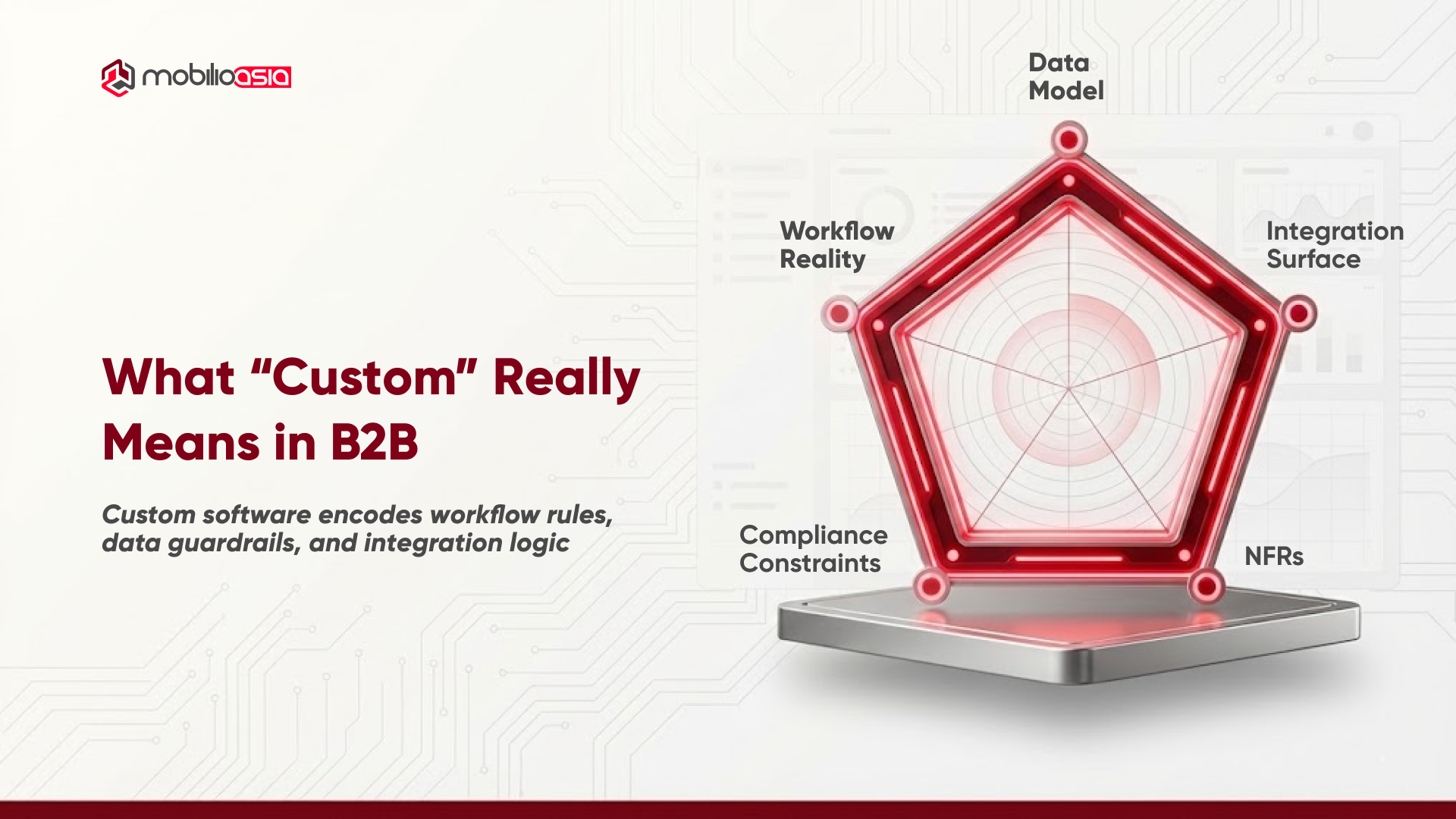
A useful way to explain it (especially for people new to product/engineering) is that custom software is “locked” around five axes:
Workflow reality
Workflow reality means the way work truly happens in the organisation not just the “happy path.” In B2B, the cost and risk typically live in exceptions and coordination: approvals by threshold, handovers across teams, rework loops, SLA timers, escalation rules, partial fulfilment, and edge cases that don’t fit a standard template. When software can’t model workflow reality, teams compensate with email, chat approvals, spreadsheets, and manual reconciliation creating delays and operational risk.
Data model
A data model is how the organisation defines “truth” in software: the core entities (customer, account, order, contract, entitlement, asset, invoice, claim depending on your domain), how they relate, and how they evolve through lifecycle states. In B2B, a strong data model also includes governance: ownership, retention, audit trails, and which system is the “source of truth.” Without a clear data model, analytics becomes fragile, integrations become expensive, and different teams unknowingly operate on different definitions of the same thing.
Integration surface
The integration surface is the real boundary between your system and everything else: ERP/CRM, payments, logistics, identity/SSO, analytics, helpdesk, partner systems, and more. It also includes how you integrate: real-time APIs vs event-driven flows vs batch synchronisation, plus practical concerns like idempotency, retries, reconciliation, and versioning. Integration is where off-the-shelf often creates long-term drag because limits, quotas, and vendor schemas shape what you can safely do.
Non-functional requirements (NFRs)
NFRs (non-functional requirements) describe how well the system must run, not what it does: security, performance, availability, observability, auditability, resilience, and recoverability (RTO/RPO). Many systems don’t fail because features are missing; they fail because reliability, monitoring, and operational controls weren’t designed in from day one especially once the system becomes business-critical.
Compliance constraints
Compliance constraints are the non-negotiable rules that shape architecture and operations. In Singapore, PDPA provides a baseline for how organisations must handle personal data collection, use, disclosure, and care. (PDPC overview)
For regulated organisations (especially financial services), MAS Technology Risk Management (TRM) Guidelines outline principles and best practices for technology risk governance and cyber resilience.
A practical definition for CTOs/POs (without sounding “too tactical”)
You build custom when the cost of mismatch becomes greater than the cost of ownership.
- Cost of mismatch shows up as workarounds, brittle integration glue, inconsistent data, delayed change, risk exposure, and a growing gap between what the business needs and what the system can safely do.
- Cost of ownership is build + run + evolve: delivery, operations, observability, security, maintenance, and the cadence to keep improving without creating new legacy.
Compared to SaaS, low-code/no-code, and “dev-only outsourcing”
Before you decide “build,” you need to understand the real trade-offs. Here’s a compact comparison that stays detailed enough to be usable in real conversations.
| Criteria | SaaS / Off-the-shelf | Low-code / No-code | “Dev-only outsourcing” |
| Core idea | You buy a ready-made product and adapt workflows via configuration | You assemble apps quickly on a platform | You hire a team to write code; success depends on your product/engineering governance |
| Fastest path to initial rollout | Fast if your process is close to the product model | Fastest for prototypes/internal apps | Not fixed depends on discovery clarity + scope + team maturity |
| Fit for unique workflow reality | Strong for standardised processes; unique exceptions create workaround pressure | Good for simple workflows; complex exceptions often hit platform limits | High fit if workflow states/exceptions are clearly defined and validated |
| Data model control | Vendor schema dictates structure; multi-SaaS stacks fragment “truth” | Often limited at scale; hard to maintain canonical entities over time | Full control possible, but requires architecture discipline |
| Integration surface | Varies by vendor: API limits/quotas, connector constraints, eventing gaps | Good for basic integrations; deep contracts and reconciliation are hard | Deep integration possible with the right patterns (versioning, retries, idempotency, reconciliation) |
| Governance and change control | Vendor roadmap/tiering shapes what you can change | Easy to change early; harder to enforce testing and control later | You must establish governance (DoD, QA gates, ADRs, release discipline) |
| Security & compliance | Heavily vendor-dependent; audit posture depends on vendor capabilities | Platform-dependent; audit/traceability can be limited | You can design for auditability and compliance, but accountability is yours |
| Long-term economics (2–5 years) | Low initial effort; costs often rise with seat/usage + add-ons + lock-in | Low for small scope; expensive when rewrites become necessary | Higher upfront; potentially more stable if the custom core is well-scoped and well-operated |
| Typical failure mode | “Mismatch tax” + vendor lock-in | Shadow IT + quality drift | Scope creep + ownership gaps + operational debt |
Now, the “sticky memory” version what your audience should remember:
SaaS: fast to deploy, but you pay for mismatch when you’re not standard
SaaS wins when your workflow is close to what the product expects and when your differentiation is not in process or data. The moment your advantage depends on unique rules, complex approvals, or deep integrations, you start paying a mismatch tax in the form of workarounds and integration brittleness. Over time, the real cost becomes the cost of slow change.
Low-code/no-code: fastest to learn, but it often hits a ceiling at product-grade scale
Low-code is excellent for validating workflows and building departmental tools quickly. But many B2B systems eventually demand stricter governance: testing discipline, environment separation, role-based access control, audit trails, and integration patterns that platforms don’t handle elegantly at scale. Low-code can still be part of a hybrid strategy but it should be chosen with clear boundaries.
Dev-only outsourcing: not a strategy just a resourcing model
Outsourcing can be a great delivery accelerator, but it doesn’t decide what you should build or how you should govern it. If you outsource without product ownership, architecture governance, and delivery discipline, you don’t buy speed you buy ambiguity.
If these options feel different, the decision comes down to three practical questions: Where is differentiation? How deep is integration and data ownership? How mature is governance and operations? Keep those in mind we’ll formalise them next.
7 signs off-the-shelf is failing
Off-the-shelf systems rarely collapse in a dramatic moment. More often, they fail quietly by becoming expensive to change, hard to integrate, and risky to operate.
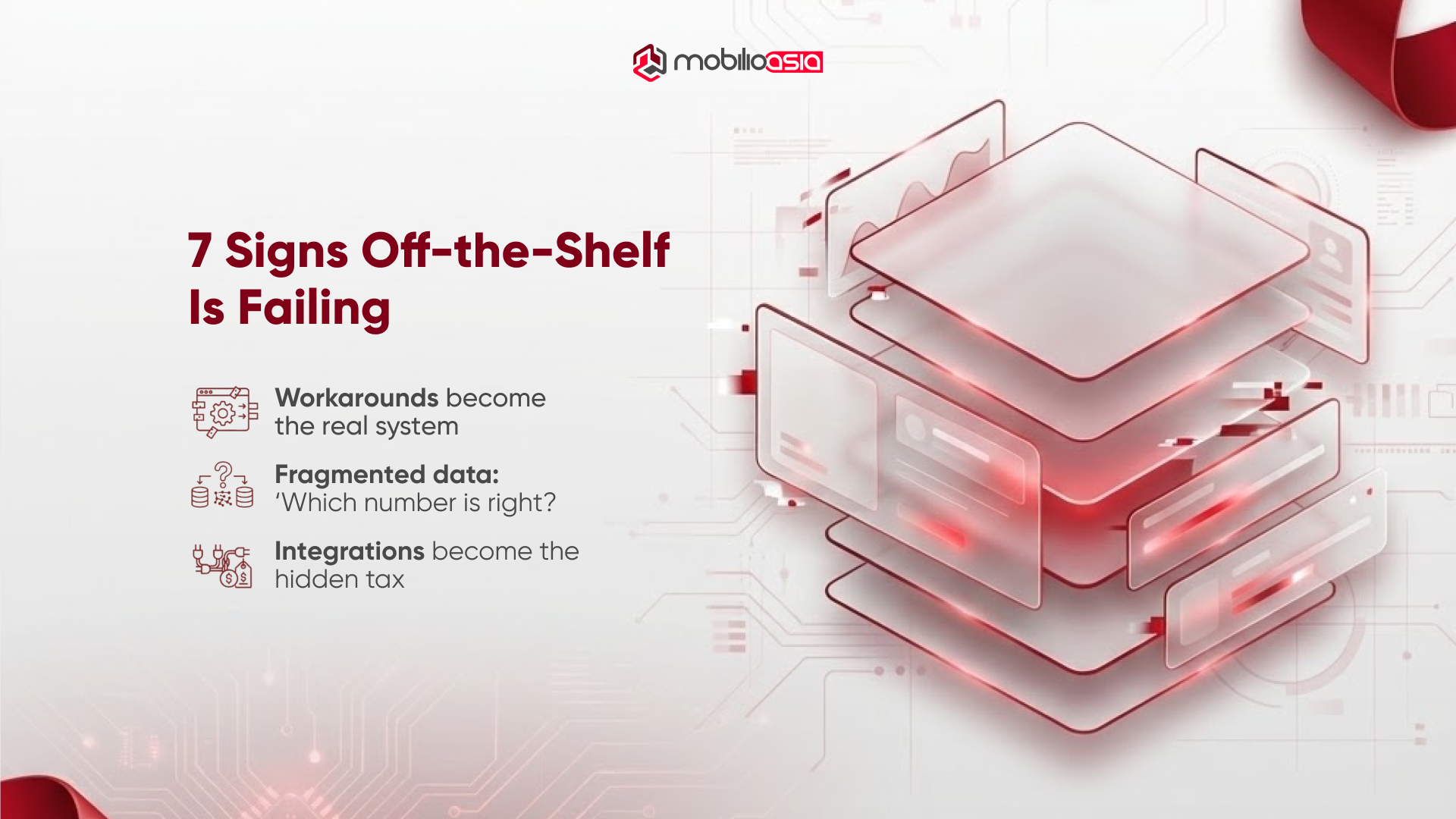
1) Workarounds become the operating system.
When Excel/Sheets become the “final source of truth,” approvals happen in email/chat, and teams copy-paste between tools, it’s a signal that the product no longer matches workflow reality. At that point, your business is not running on SaaS it’s running on an informal layer that has no audit trail, no consistent definitions, and no reliable control.
2) Data fragmentation makes decisions unreliable.
When pricing, entitlements, transactions, and customer records live across multiple tools with inconsistent definitions, you lose confidence in reporting. Teams spend time arguing which number is correct, waiting on batch jobs, and manually reconciling inconsistencies. This is not an analytics problem; it is a data model ownership problem.
3) Integration becomes the bottleneck and the hidden budget sink.
In B2B, the system is rarely “one tool.” It’s a chain across ERP/CRM, payments, logistics, identity, reporting, and partner ecosystems. Off-the-shelf limitations often show up here first: quotas, per-call costs, inconsistent identifiers, weak eventing/webhooks, and brittle synchronisation jobs. The longer you patch integrations, the more you turn “deployment speed” into “change paralysis.”
4) Scaling limits appear as product constraints, not performance graphs.
Scaling is not only throughput. It’s multi-entity operations, multi-market rules (currency/tax/language/policy), a growing permission model, and higher auditability requirements. If the SaaS model can’t express these cleanly, scaling forces you into awkward workarounds and operational complexity.
5) Security/compliance gaps widen as vendors multiply.
In Singapore, PDPA sets baseline obligations for personal data.
As your workflow touches personal or sensitive data across multiple SaaS tools, the attack surface expands and audit burden increases. For regulated environments, governance expectations (including technology risk management practices) raise the bar further, often beyond what “configuration only” can safely cover.
6) Vendor lock-in becomes a roadmap constraint.
You feel locked-in when critical workflows are gated behind enterprise tiers, missing capabilities are “on the roadmap,” and switching costs are dominated by migration, retraining, and rewriting integrations. This isn’t only a procurement issue; it is a product speed issue.
7) You can’t differentiate because competitors can buy the same stack.
If your “unique capability” is a standard module in popular SaaS, your long-term levers narrow to pricing and marketing. That’s often the moment organisations start building a custom core because software becomes part of the competitive moat.
This matters more now because SaaS cost inflation is real. CIO.com reports SaaS subscription costs rising 10%–20% in a year while IT budget growth projections are around 2.8%, increasing pressure to reassess “buy forever” economics.
Build vs Buy vs Hybrid: a decision framework you can actually use
Build vs buy is not a purely technical debate in B2B it’s a risk and execution debate. BCG’s research shows that only 30% of transformations meet or exceed target value with sustainable change, meaning the wrong system choice can quietly reduce your probability of success by increasing adoption friction, integration complexity, and operating-model strain.
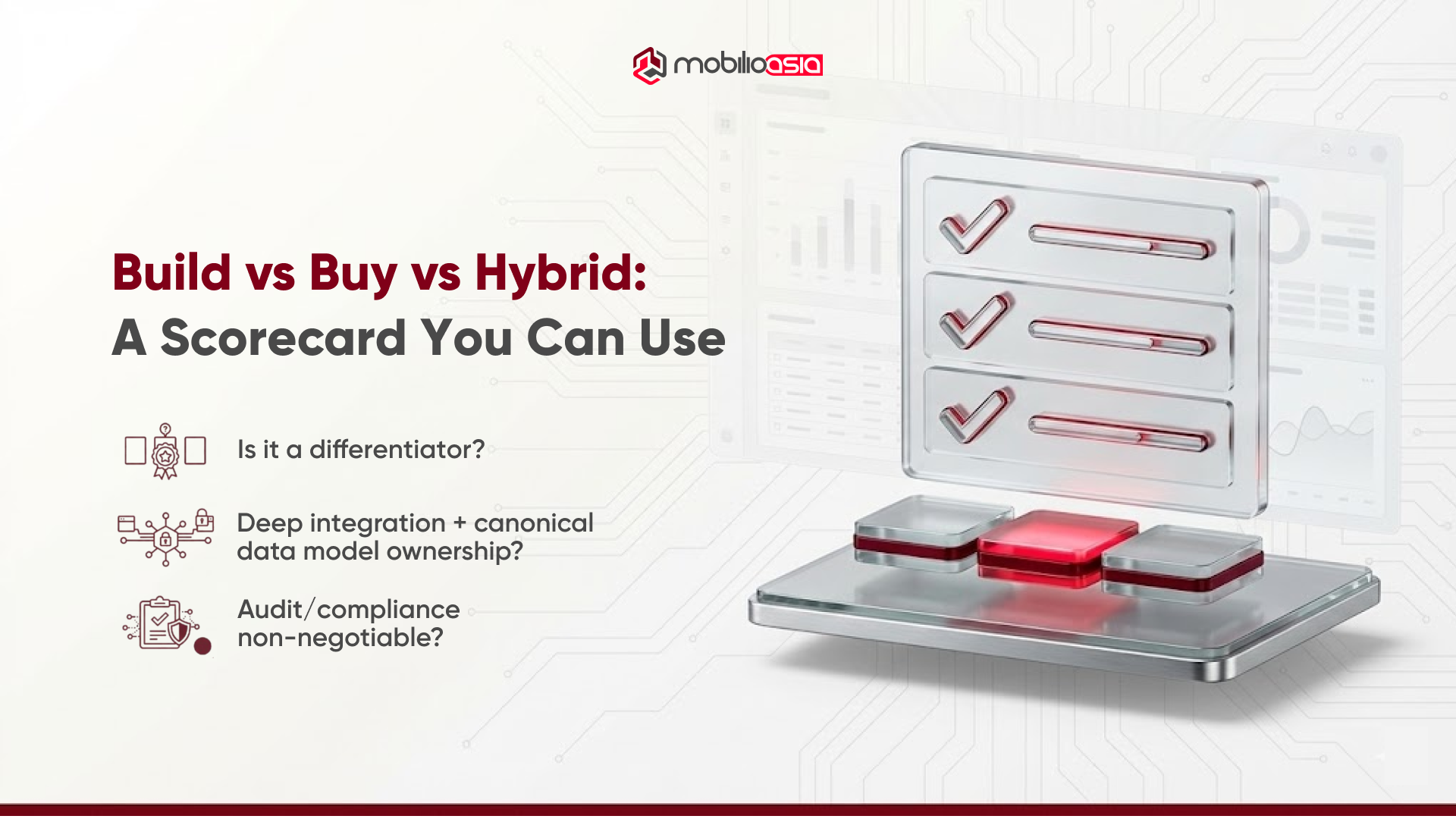
A practical framework starts with three questions that both technical leaders and non-technical executives can align on:
1) Is this a core differentiator?
If the capability directly impacts revenue, margin, retention, or operational advantage, you should be cautious about locking it into vendor constraints. Differentiators change faster than vendor roadmaps, and the cost of waiting becomes a real opportunity cost.
2) Does it require deep integration and a unified data model?
If the system must orchestrate multiple internal/external systems and maintain consistent definitions (customer, contract, entitlement, pricing, status), a custom core often becomes the most reliable “control plane.” SaaS can still play a role, but the orchestrating logic is rarely a good fit for point-to-point glue.
3) Are compliance and audit requirements non-negotiable?
PDPA provides baseline obligations for personal data handling in Singapore. (PDPC overview)
When auditability and governance requirements are strict, “configuring around tool limitations” can turn into risk exposure: unclear access control, weak traceability, inconsistent retention, and fragile incident response pathways.
Then, evaluate ROI the way B2B systems actually create (or destroy) value:
- Time-to-value: how quickly you deliver measurable operational improvement, not just deployment.
- Cost of change: how expensive each policy/workflow/integration change becomes over time.
- Risk: security posture, audit burden, and blast radius when incidents occur.
- Opportunity cost: what you cannot ship because the stack constrains you.
Scorecard output: Buy / Hybrid / Build
| Dimension | Buy (SaaS) | Hybrid (custom core + SaaS) | Build (custom) |
| Differentiation | Low | Medium–High | High |
| Integration depth | Low | Medium–High | High |
| Data model ownership | Low | Medium | High |
| Compliance/audit control | Vendor-dependent | Shared control | Full control |
| Change frequency | Low | Medium | High |
| 3–5 year cost predictability | Medium (tier/usage risk) | Medium–High | Medium (depends on ops maturity) |
A simple rule of thumb works surprisingly well in Singapore/Asia contexts: if differentiation, integration depth, and compliance complexity are all low, buy. If you need a control plane but can keep commodity modules as SaaS, go hybrid. If workflow + data model is the product (or the risk boundary), build the core.
What you gain with custom software development: outcomes backed by technical proof
Process fit: fewer manual steps, fewer errors, shorter cycle time
The fastest visible impact of custom software development is often operational: removing the manual “glue” people use to compensate for mismatched tools. Custom systems can model workflow as disciplined states and transitions where approvals, SLAs, escalation rules, and exception handling are enforced by the system, not by tribal knowledge. When that happens, cycle time is no longer a debate; it becomes measurable. The same workflow can be instrumented before and after, turning ROI into operational evidence rather than opinions.
Data advantage: analytics/AI-ready by design, not by purchasing another tool
Many organisations try to become “AI-ready” by adding AI tooling. But AI value and AI risk are both downstream of data quality, lineage, and guardrails. Custom systems let you define canonical entities, stable identifiers, governance rules, and audit trails so analytics is consistent and automation is safe. This matters because IMDA’s figures suggest that most firms rely on off-the-shelf genAI tools, while a large share already invests in customised/proprietary AI: the differentiation is increasingly in data + workflow + guardrails, not in having access to a generic model.
Integration leverage: less brittle glue, more reliable end-to-end execution
In many B2B systems, the real complexity is not UI its end-to-end integrity across systems. A well-designed custom core introduces explicit contracts (API/schema/versioning), reliable retry semantics (idempotency), and intentional reconciliation patterns. This reduces the operational burden of debugging silent sync failures and gradually converts integration from “constant firefighting” into an engineered capability.
Ownership and roadmap control: predictable change velocity
When your roadmap is gated by vendor tiers, deprecations, and pricing model shifts, product speed becomes fragile. Custom systems return control of sequencing and quality attributes performance targets, observability coverage, and service objectives so trade-offs are made internally, not by constraint. This is especially relevant when SaaS prices rise faster than budgets, as reported by CIO.com: the economics of “buy forever” become less predictable.
Scalable B2B architecture: scale means complexity, not just load
For Singapore and multi-market Asia operations, “scale” often means multi-currency, multi-language, local compliance variations, partner role/permission growth, and stronger audit requirements. A custom core can be designed to handle these pressures structurally so the system grows with operations instead of being reworked under stress.
Common use cases across industries (web + app): a pattern library
Field operations (mobile + offline-first).
Off-the-shelf field apps often work for simple checklists, but break down when dispatch changes frequently, evidence capture needs strict templates, approvals require traceability, and connectivity is unreliable. Customisation here is not cosmetic; it is architectural. Teams typically customize the offline data model (what must exist locally), synchronisation rules (how conflicts resolve), and workflow state machines (what happens when exceptions occur). Early wins often look like fewer re-entries, fewer missing documents, fewer SLA breaches, and shorter completion cycles because the system enforces steps that used to live in phone calls and spreadsheets.
B2B portals for ordering, entitlements, and contract pricing.
Generic portals rarely model what actually drives B2B revenue: contract-specific pricing, entitlement rules, approval thresholds, credit limits, and market-specific fulfilment constraints. Custom software development typically focuses on building a rules-capable core (entitlements + pricing logic), then integrating that with ERP/OMS/CRM so customer-facing and internal systems share the same truth. The practical impact is fewer disputes (“which price applies?”), fewer manual back-and-forth loops between sales/ops/finance, and more self-service without losing governance.
Onboarding/KYC and workflow engines.
Many organisations start with form builders, then hit a wall when onboarding requires multi-step verification, multiple data sources, and auditable approvals. Customisation is usually centred on a workflow engine that encodes states, routing rules, and audit trails, plus integration hooks for identity checks, document verification, and risk scoring that can vary by market. The immediate benefits are reduced queue bottlenecks, fewer incomplete submissions, and faster onboarding that remains compliant.
Claims/case management and exception-heavy operations.
Ticketing tools are great for simple cases; they struggle when a “case” has lifecycle states, branching paths, multiple handovers, and hard SLA/traceability requirements. Customisation often includes formalising the case lifecycle, building routing/triage logic, and embedding evidence collection and approvals into the process. Operationally, this tends to improve SLA compliance and provides management visibility into why delays happen, enabling real process optimisation.
Integration hub / control plane.
When stacks grow, point-to-point integrations create an unmanageable dependency graph: one change breaks many flows, and data inconsistencies become costly to trace. A custom control plane standardises contracts, centralises reconciliation, and improves reliability via engineered retry semantics turning integration into an asset rather than an ongoing liability.
Self-service automation for support reduction.
Helpdesk automation works until self-service touches entitlements, pricing, or transactional state changes across systems. Customisation builds transactional workflows with guardrails and audit trails, which reduces repetitive tickets and removes ambiguity from operations.
Across all these patterns, custom software rarely “rewrite everything.” The repeatable model is commodity SaaS where it’s truly standard + a custom core where workflow/data/integration create advantage or carry risk.
A delivery approach that avoids scope creep
Scope creep is rarely a personality problem. It is usually a product definition problem: teams start building before they agree on the smallest end-to-end outcome that proves value. That’s dangerous in a world where execution gaps are common; BCG’s research on transformation outcomes is a reminder that success depends on disciplined execution and measurable progress, not just good intentions.
A practical delivery approach begins with Discovery (2–6 weeks) as a way to buy clarity before buying a large volume of code. A credible discovery produces artefacts that a CTO can review and challenge: a domain map (what is core vs peripheral), a first-pass data model for canonical entities, an integration map showing systems, ownership, and real-time vs batch needs, and a risk register covering security/compliance/performance. Most importantly, it ends with an MVP definition tied to success metrics cycle time reduction, error rate reduction, adoption targets so the team can decide what “done” means in operational terms.
Then comes iterative delivery that is product-grade, not feature-factory. That means each increment is engineered to run: appropriate automated testing (unit/integration/contract where needed), CI/CD with release gates, observability (logs/metrics/traces), and security reviews focused on the real risk points (identity, authorisation, sensitive data handling). When delivery is structured around outcome slices, scope becomes easier to control because features are judged against whether they move the metrics that were agreed upon in discovery.
Finally, adoption must be treated as an engineering deliverable, not a slide deck. Real adoption work includes migration scripts with verification, cutover planning that avoids dual-system chaos, rollback paths that reduce go-live risk, and instrumentation to measure whether users are actually completing workflows in the new system. Without these, the organisation quietly returns to workarounds creating the illusion of progress while the mismatch tax continues to grow.
Cost & timeline drivers: explain it credibly
The fastest way to lose trust with technical buyers is false precision. In B2B, cost and timeline are rarely driven by the number of screens; they are driven by workflow complexity, integration depth, migration effort, and security/compliance requirements.
Cost drivers (and why they move budgets)
| Driver | What it means | Why it drives cost | How to control it |
| Workflow complexity | States, exceptions, approvals, permissions | More edge cases → more logic + testing + QA | Lock MVP around outcomes and must-have states |
| Integrations | Number of systems + contract stability | Mapping, retries, quotas, reconciliation add complexity | Build an integration map early; prioritise high-value integrations |
| Security & compliance | Access control, audit trails, encryption, retention | Requires design + controls + operational processes | Create a risk register and classify sensitive data early |
| Data migration | Quality, duplicates, mapping, historical scope | “Dirty data” extends timelines and increases risk | Profile data early; decide “current state vs full history” |
| UX complexity | Roles, channels, workflow variation | Each role needs flows and permission-specific UI | Limit MVP roles; focus on core journeys |
| Mobile/offline-first | Sync, conflict resolution, device constraints | Offline reliability is hard engineering | Use only when required; define offline scope precisely |
T-shirt sizing (for early planning without guessing)
| Tier | Goal | What you typically build | Typical timeline (illustrative) |
| Pilot / MVP | Prove one end-to-end workflow with real value | One core workflow + 1–2 critical integrations + measurable metrics | ~8–12 weeks (plus discovery) |
| Growth system | Expand workflows and harden reliability | More roles/workflows, stronger governance, observability, scalability | ~3–6 months |
| Enterprise modernisation | Rewire/replace core systems and migrate heavily | Phased rollout, complex migration, deeper compliance/audit needs | ~6–12+ months |
Timeline by phase (easy to explain to stakeholders)
| Phase | Goal | Concrete outputs | Typical duration |
| Discovery | Align on scope, risks, and success metrics | Domain map, draft data model, integration map, risk register, MVP backlog | 2–6 weeks |
| MVP build | Deliver a working end-to-end slice | Core workflow + minimum integrations + UAT plan + metrics | 6–10 weeks |
| Hardening | Make it reliable to run | Tests, CI/CD gates, observability, security checks, runbooks | 2–6 weeks |
| Rollout & adoption | Go-live safely and drive usage | Migration scripts, cutover/rollback plan, adoption telemetry | 2–8 weeks |
A credible estimate typically requires at least three artefacts: a draft data model, an integration map, and a risk register. Without those, numbers are optimism not engineering.
Risks and how to de-risk (especially in regulated environments)
Custom projects rarely fail because “developers weren’t skilled.” They fail because scope is ambiguous, ownership is weak, operational readiness is missing, or rollout is underplanned. The good news is that these risks can be reduced systematically with governance and delivery discipline.
PDPA provides baseline data protection expectations in Singapore, and for regulated environments governance expectations extend into operational practices like access review, logging, incident handling, and vendor controls.
For financial services, MAS TRM is widely referenced as a best-practice benchmark for technology risk management and cyber resilience in Singapore.
The key is to treat compliance and security as governance + auditability + operations, not as a late-stage checklist.
How to choose a partner for custom software development in Singapore & Asia
Demand is growing, and so is vendor variance. Grand View Research’s Horizon outlook estimates Asia Pacific custom software development revenue at US$10,947.3M (2024), reaching US$42,248.4M by 2030, with a 25.3% CAGR (2025–2030). Growth attracts talent and it also attracts “slideware,” where vendors sell confidence more than capability.
Practical market map (fit > fame).
This is not a “best vendor” list. Your fit depends on delivery model, governance maturity, and compliance constraints.
1) Mobilio (Vietnam) product & platform engineering partner
Best when you need: outcome-driven workflow design, strong engineering discipline, and delivery governance (security, QA gates, observability), without SI overhead.
2) Singapore-based / Singapore-headquartered systems integrators
Typically strong for enterprise delivery structures, regulated environments, and long-term managed engagements.
3) Global consultancies & large SIs
Best for large-scale transformation programs (operating model + enterprise architecture + multi-vendor governance). Trade-off: higher cost, heavier process, slower iteration for product-style builds.
4) Product engineering / tech consultancies
Strong for discovery-to-delivery, engineering excellence, and scalable product teams. Trade-off: ensure commercial model + accountability is clear across delivery phases.
5) SEA/Vietnam delivery partners
Great leverage when your governance is strong (clear scope boundaries, integration ownership, and quality controls). Trade-off: without strong governance, you’ll pay a “coordination + integration tax.”
The checklist that actually filters quality
A credible partner should demonstrate product capability (discovery rigor, BA/PO strength, UX competence), security readiness (access control patterns, audit logging approach, secure SDLC), delivery governance (Definition of Done, QA automation, CI/CD maturity), and proof of outcomes (case studies with measurable impact, not just feature lists). They should also be explicit about ownership and handover: documentation, runbooks, source control, IP clarity, and a support model that keeps the system healthy after go-live.
Where Mobilio fits: If you want a partner that approaches custom software development as product delivery (not just “writing code”), Mobilio typically starts with a structured Discovery (domain mapping, draft data model, integration map, risk register), then delivers an MVP tied to measurable outcomes while embedding governance, quality gates, security, and observability from day one so the system is not only shipped, but operated and evolved safely across Singapore and Asia.
Conclusion
When an off-the-shelf stack forces teams to run critical workflows through spreadsheets, approvals through chat, and reconciliation through manual effort, the real issue is no longer “we need another tool.” The issue is that mismatch cost is rising faster than the value the tools deliver especially once integration depth, audit expectations, and multi-market complexity start to grow. In a Singapore and Asia market where digital adoption is already mainstream, the winning advantage shifts toward systems that fit workflow reality, unify data, integrate reliably, and can be adopted at scale without generating hidden operational debt.
A high-leverage next step is not another configuration cycle, but a structured Build vs Buy vs Hybrid assessment grounded in your real workflow and integration surface. If you want to move quickly, start with a Build-vs-Buy scorecard based on your current processes and system map. If you need a deeper foundation, a 2–6 week Discovery workshop can produce the artefacts that make decisions credible: MVP scope tied to success metrics, a draft data model, an integration plan, and a risk register that surfaces security/compliance realities early. If you’d like, Mobilio can run this assessment and Discovery as the first phase of a measurable custom delivery plan designed to reach value fast while keeping long-term ownership and reliability under control.
FAQ
Is custom software development worth it for SMEs?
Often, the best answer is not “build everything” or “buy everything,” but hybrid by design. When most SMEs already use digital tools, the differentiator becomes whether the system fits real operations and can evolve without creating manual workarounds. If your SME’s advantage depends on workflow rules, reliable integrations, or a consistent data model, a small custom core can eliminate mismatch cost while SaaS continues to handle commodity functions.
Custom vs SaaS: which one launches faster?
SaaS launches faster when your process matches the product model and integrations are shallow. But when SaaS requires heavy workarounds, complex integration glue, and constant reconciliation, the “fast launch” can delay real operational value. A properly scoped custom MVP can reach meaningful value quickly by delivering one end-to-end workflow with real integrations and measurable outcomes then iterating from a stable foundation.
How do you prevent scope creep in a custom software project?
Scope creep drops sharply when “success” is defined as measurable operational change, not a long feature list. Discovery should lock MVP scope to outcomes (cycle time, error rate, adoption targets), and delivery should release in value slices with instrumentation. When every new request must answer “which metric improves, and what risk does it introduce,” scope becomes a disciplined trade-off rather than a silent expansion.
What are typical discovery outputs?
A credible discovery normally produces a domain map, draft data model, integration map (systems, ownership, real-time vs batch flows), a risk register (security/compliance/performance), and an MVP backlog tied to success metrics. These outputs are what make cost and timeline estimates believable.
Who owns maintenance and evolution after go-live?
A sustainable custom system needs an explicit operating model: monitoring and alerting, incident response, runbooks, and a roadmap cadence that prevents today’s system from becoming tomorrow’s legacy. Whether the work is done internally or with a partner, ownership must be clear, and service objectives should be defined so reliability and delivery remain aligned.
If you’d like to go deeper, here are a few Mobilio reads we often reference when helping teams make build-and-delivery decisions:
- Mobile-first strategy: how to design product strategy for markets where mobile is the default, not a channel.
- Data/AI advantage: turning analytics into a strategic lever (beyond dashboards) when uncertainty is high.
- Product messaging vs reality: why positioning can look “right” while the product system underneath can’t deliver.
Sourcing strategy: a pragmatic view of Vietnam delivery leverage—what it enables, and the governance it requires.

Pingback: Website vs Web Application: 9 Critical Differences to Avoid
Pingback: Application Development Outsource: 9 Proven Ways to Win
Pingback: Outsourcing App Development: 9 Proven Steps to Launch Fast