

 Tiếng Việt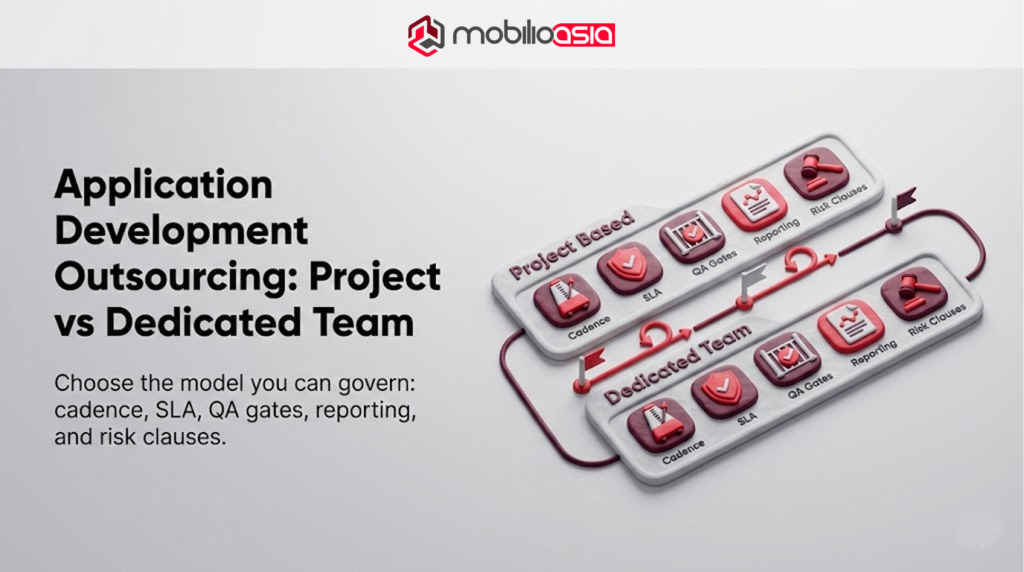
If you application development outsource with the wrong engagement model, the cost shows up later as missed timelines, surprise scope, QA churn, and release stress. The vendor might be strong, but the system is weak.
This guide helps you application development outsource with control. You will compare project based delivery and a dedicated team using governance you can enforce: cadence, SLA, QA gates, reporting, and risk clauses.
If you also want alignment on product strategy and outcomes, start with these internal reads:
-
Mobile-First: The Strategic Imperative for Digital Products in a Mobile-Driven Market
-
AI-powered Analytics: The Strategic Lever in an Uncertain Market
-
What Is Custom Software Development? When Off-the-Shelf Fails
Table of contents
Project vs dedicated team in 5 minutes
When you application development outsource, you usually choose one of two models.
Model A: Project based outsourcing
You buy a defined scope delivered by milestones. Pricing is often fixed price or milestone based time and materials.
Best when requirements are stable and acceptance criteria are measurable.
Model B: Dedicated team
You retain team capacity to deliver a roadmap in sprints. Pricing is often monthly retainer or capacity based time and materials.
Best when requirements evolve and you want continuous delivery.
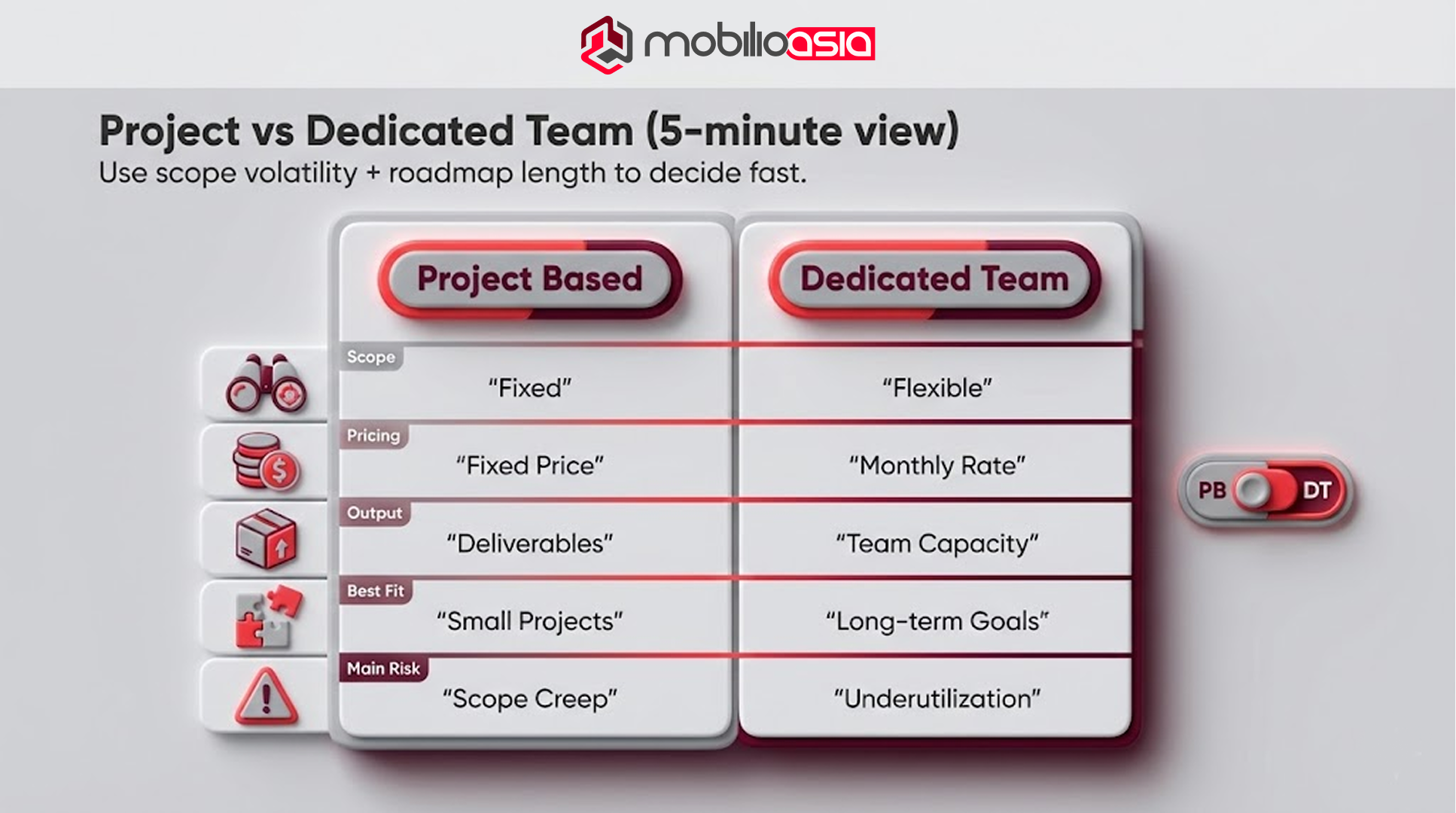
Use this decision table:
| Dimension | Project based | Dedicated team |
|---|---|---|
| Scope | Stable, controlled change | Evolving, learning driven |
| Commercial model | Fixed price or milestone time and materials | Retainer or capacity time and materials |
| Output focus | Deliverables and milestones | Outcomes and release cadence |
| Best fit | One clear release | Ongoing iteration and scale |
| Main risk | Change disputes | Drift without governance |
Add this image near the top to satisfy Rank Math and improve scanability.
If your product must move fast on mobile, model choice matters because iteration speed is part of the product. Read Mobile-First: The Strategic Imperative for Digital Products in a Mobile-Driven Market.
Rule 1: application development outsource by scope volatility
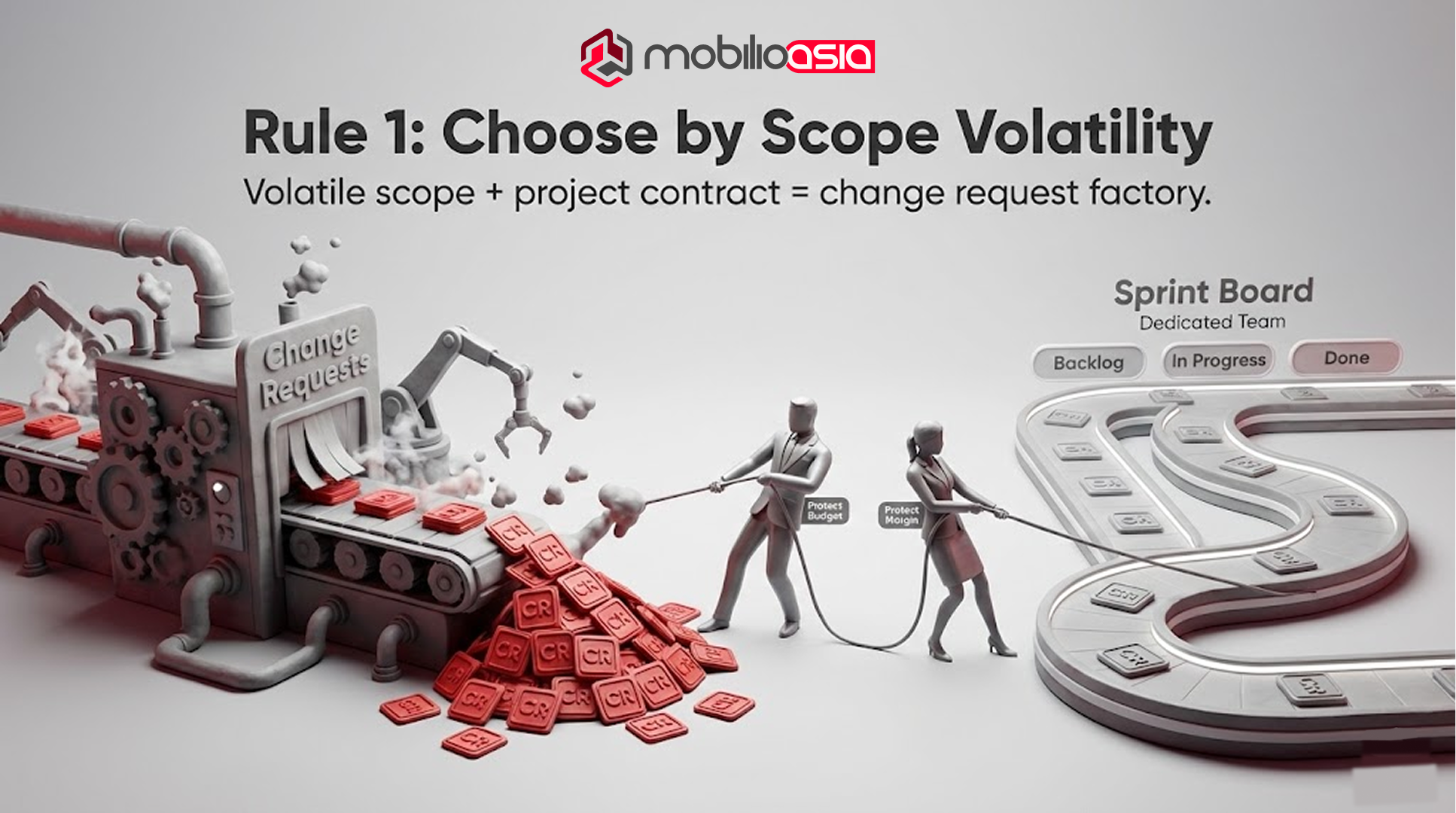
If you application development outsource as a project while scope is still moving, the relationship becomes a change request factory. The vendor is forced to protect margin. You are forced to protect budget. Delivery slows.
Choose project based when scope is stable:
-
User journeys are approved
-
Data model is defined
-
Integrations are limited and documented
-
Definition of done is measurable
-
Post launch iteration is limited
Choose a dedicated team when scope is volatile:
-
Discovery is incomplete
-
Stakeholders have competing priorities
-
Integrations have unknowns
-
Analytics will change priorities after launch
-
You expect multiple releases
A useful external reference on structuring agile delivery commercially is the UK government guidance on contracting for agile. Use it as a sourcing benchmark for change control, governance, and acceptance. See Contracting for Agile Guidance Note.
Rule 2: Choose by roadmap length
Roadmap length is a fast proxy for what will work when you application development outsource.
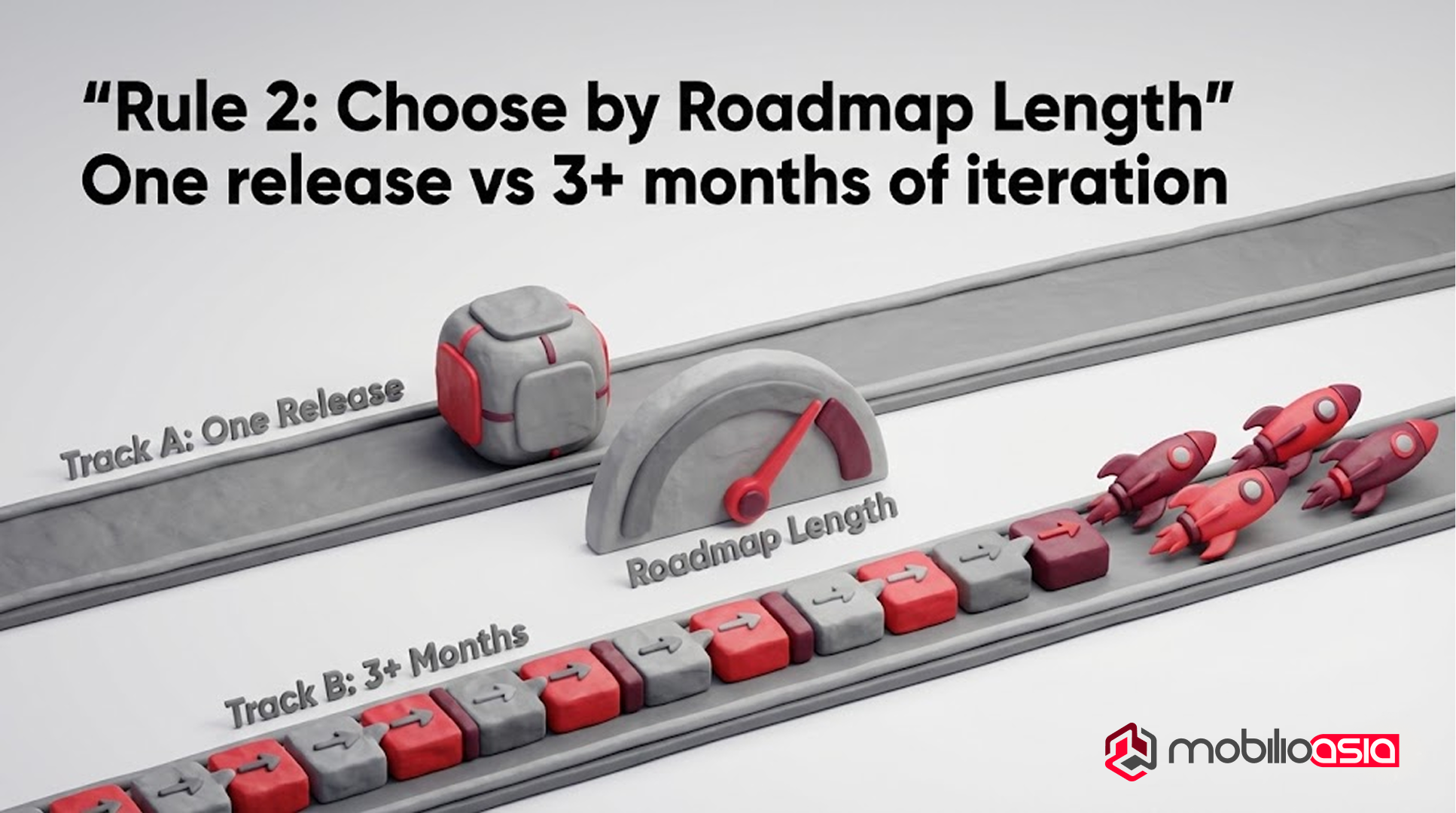
Project based fits when:
-
You need one release
-
You can define acceptance criteria up front
-
Your internal team can operate and iterate after handover
Dedicated team fits when:
-
You have a roadmap of three months or more
-
You plan to release regularly
-
You expect iteration on UX, performance, analytics, and security
If your roadmap is driven by insight and measurement, align delivery with a loop of ship, learn, improve. Read AI-powered Analytics: The Strategic Lever in an Uncertain Market.
Rule 3: Match pricing to uncertainty
Application development outsource contracts fail when pricing conflicts with uncertainty.
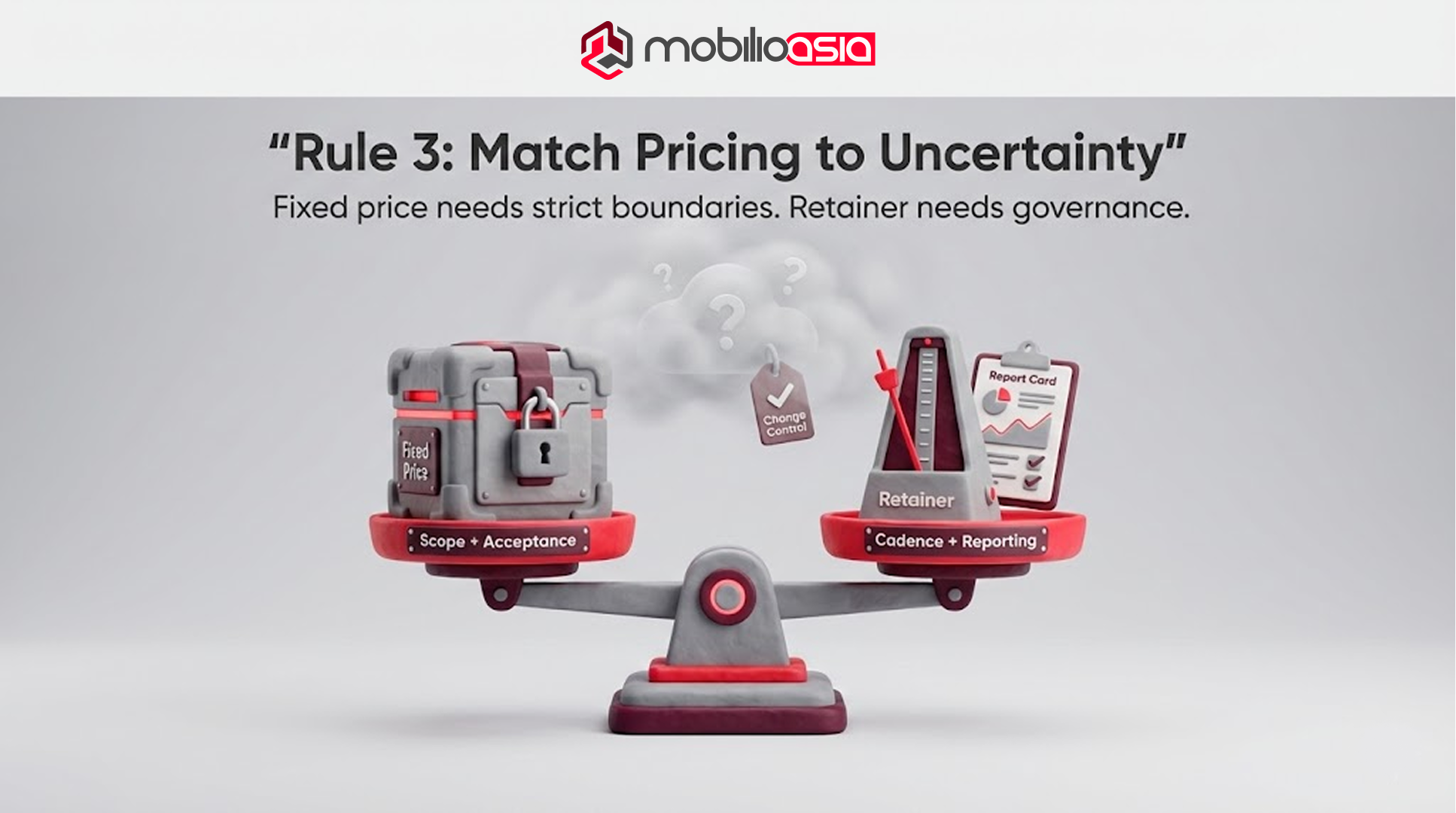
Project based pricing
Fixed price can work only when scope boundaries and acceptance criteria are strict.
If you choose fixed price, require:
-
Clear scope boundaries
-
Acceptance criteria per milestone
-
A change request process that includes time and cost impact
-
A definition of done that includes QA gates and release readiness
Milestone time and materials is often safer when scope is mostly clear but details need flexibility.
Dedicated team pricing
A monthly retainer buys stable capacity. Predictability comes from consistent cadence and reporting, not from pretending scope is fixed.
To avoid a retainer feeling open ended, agree on:
-
Quarterly outcomes
-
Sprint goals and demo based acceptance
-
An agreed backlog ownership process
For sourcing context and governance emphasis, you can reference Deloitte’s outsourcing research. See Deloitte Global Outsourcing Survey.
Rule 4: Set a delivery cadence that keeps shipping
When you application development outsource, cadence is the engine. Without cadence, you only have status updates.
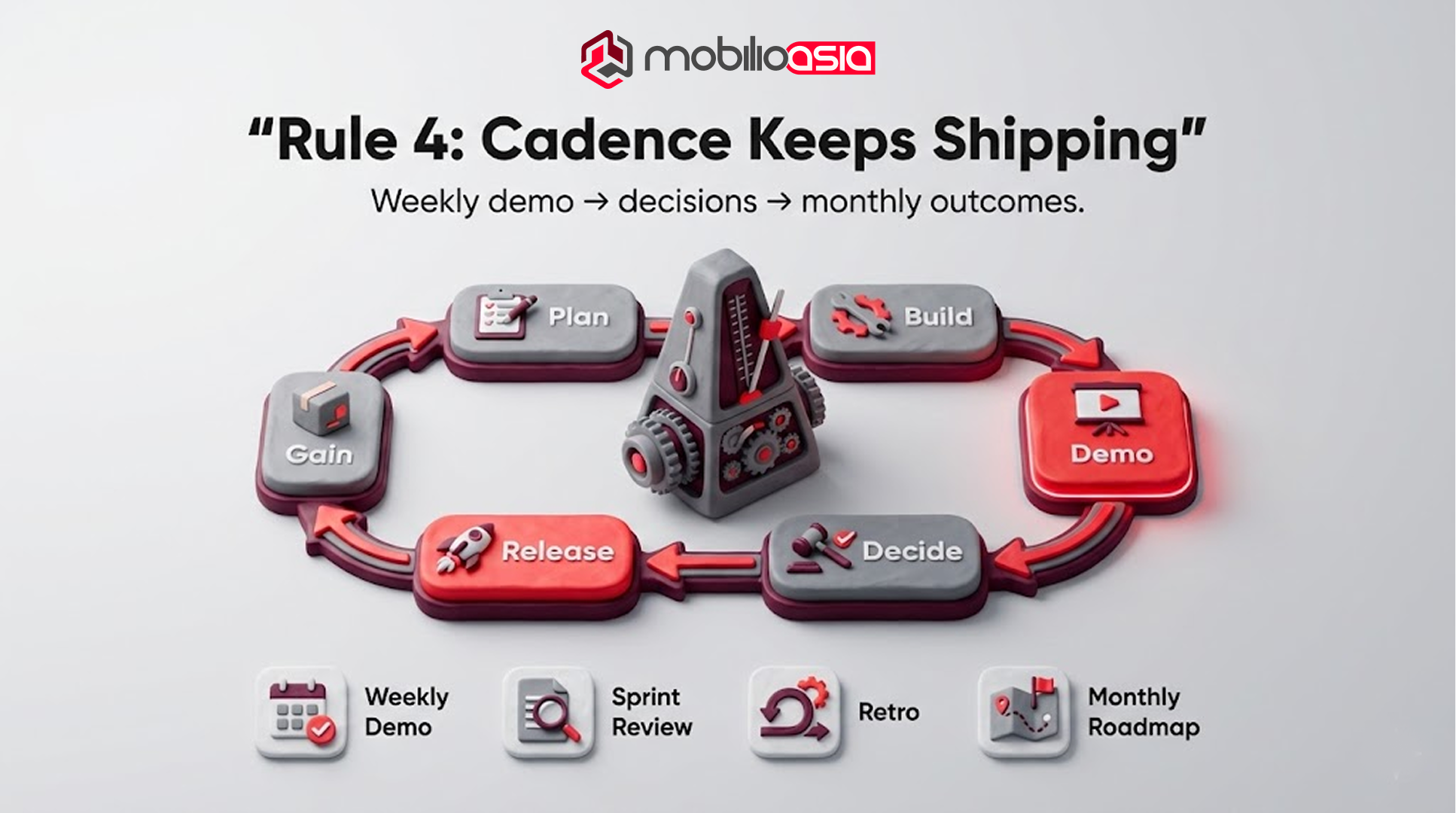
Minimum operating rhythm:
-
Weekly demo with working software
-
Sprint planning, review, and retrospective
-
Weekly decision sync for blockers and approvals
-
Monthly roadmap review focused on outcomes
Write down decision owners for:
-
Priority and scope tradeoffs
-
Release timing
-
Security requirements
-
Data and integration access
If your team is building AI enabled features, you also need a cadence for feedback and adoption, not just engineering tasks. Read Marketing AI Products: Why FMCG Thinking Is Holding Tech Companies Back.
Rule 5: Define an SLA that protects production
If you application development outsource without an SLA, incidents become negotiation.
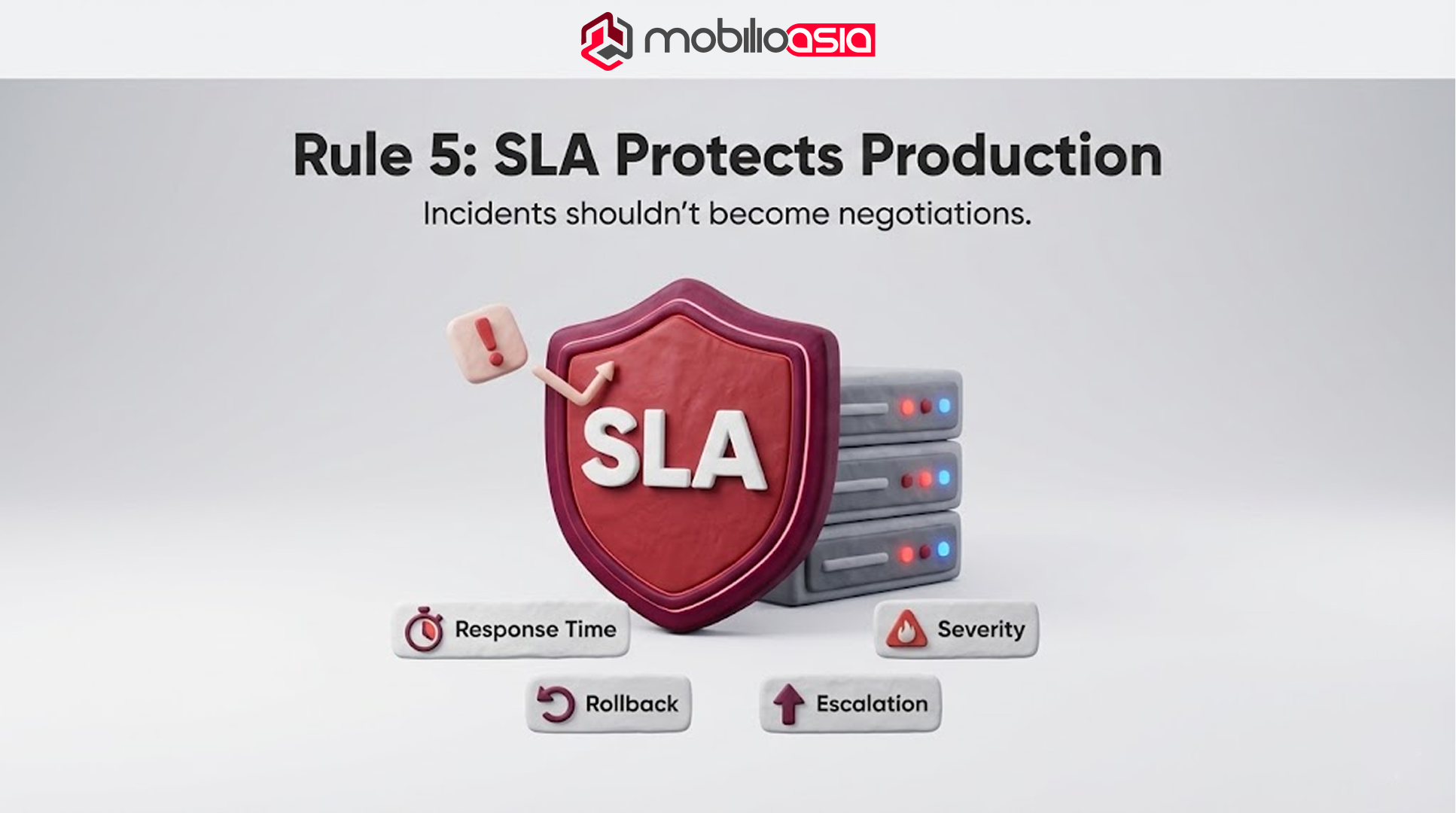
Your SLA should cover:
-
Response time for questions and incidents
-
Bug severity classification and target resolution time
-
Release readiness criteria
-
Rollback expectations
-
Escalation path and named owners
Keep it enforceable. One page is often enough if it is specific.
You can also align SLA and reporting with common delivery reliability thinking. A practical starting point is the DORA guidance on delivery performance and reliability. See DORA metrics guide.
Rule 6: Enforce QA gates before every release
When teams skip QA gates, you pay later. If you application development outsource without release gates, the system will create production risk.
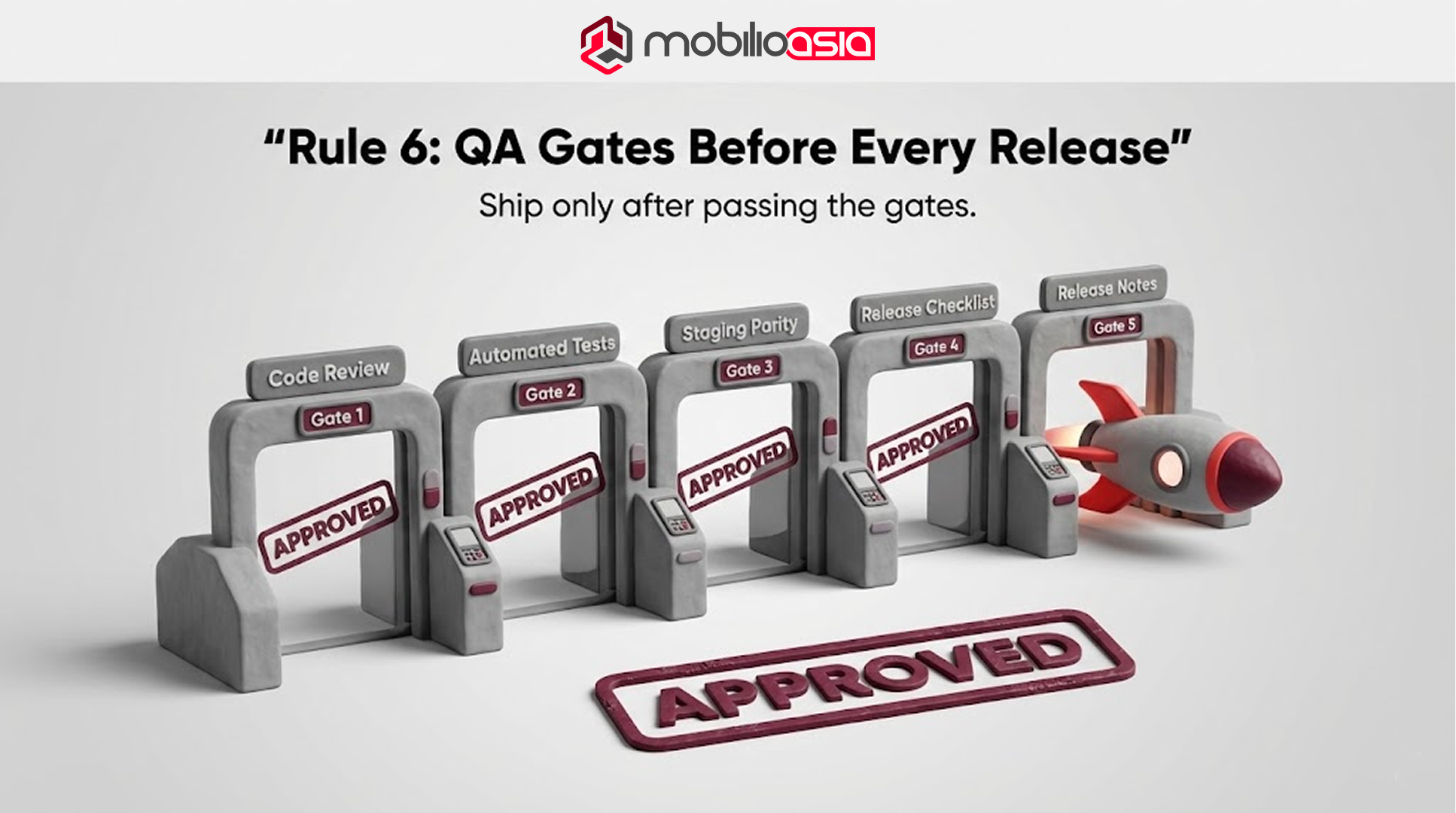
Minimum release gates:
-
Code review required for every merge
-
Automated tests for critical paths
-
Staging environment aligned with production config
-
Release checklist and owner sign off
-
Release notes for every deployment
Add this image in the QA section.
If you want a security maturity structure that connects to QA and SDLC practices, link to an external reference like OWASP SAMM.
Rule 7: Lock IP and security from day one
Most risk is preventable if you lock it early. This is a core control area when you application development outsource.
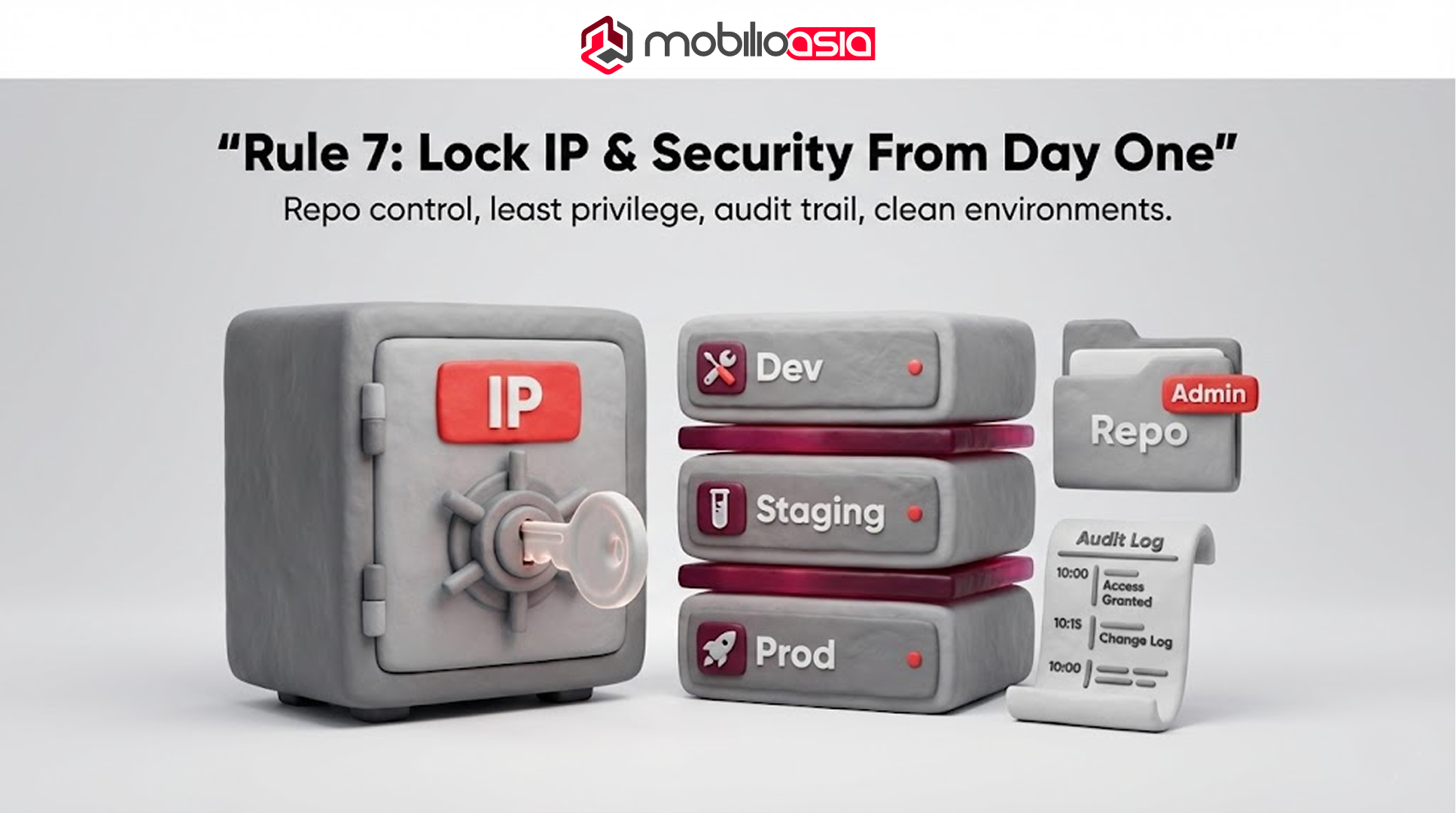
IP controls
-
IP assignment and ownership clarity in the contract
-
Source code repository owned by your organization or admin access granted to your organization
-
Documentation and handover package defined as a deliverable
-
Exit clause and transition support
Security controls
-
Least privilege access to systems and data
-
Separate dev, staging, and production environments
-
Audit trail for access and deployments
-
Secure development expectations aligned to a recognized framework
Two external references you can cite and link in this section:
If your delivery is in Vietnam, include security and access controls from day one, not after the first release. For local context, read Why Vietnam Is Becoming Asia’s Fastest-Growing Software Outsourcing Hub in 2026.
Rule 8: Use delivery metrics to prevent drift
Dedicated teams fail when progress is invisible. Projects fail when acceptance is subjective. Metrics reduce both issues.
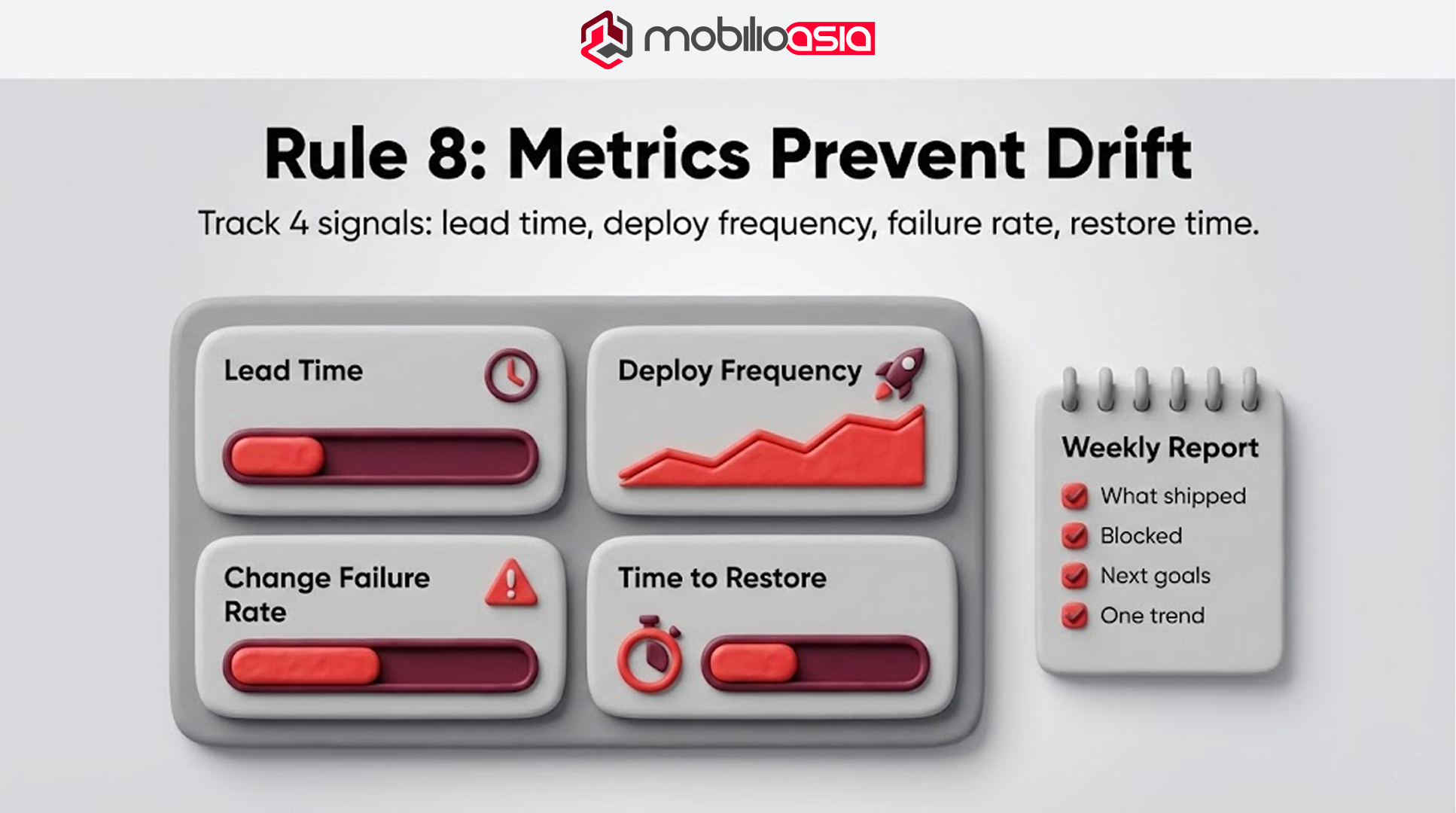
If you application development outsource, track a small set of delivery signals:
-
Change lead time
-
Deployment frequency
-
Change failure rate
-
Time to restore service
These are widely used as delivery and reliability indicators. Start with the external reference and keep it simple. See DORA metrics guide.
Weekly reporting can be a short page:
-
What shipped
-
What is blocked and why
-
Next sprint goals
-
One metric trend
If you are measuring product outcomes, connect delivery to analytics and adoption. Read AI-powered Analytics: The Strategic Lever in an Uncertain Market.
Rule 9: Pilot first, then commit
A safe pattern for application development outsource is to earn the right to scale.
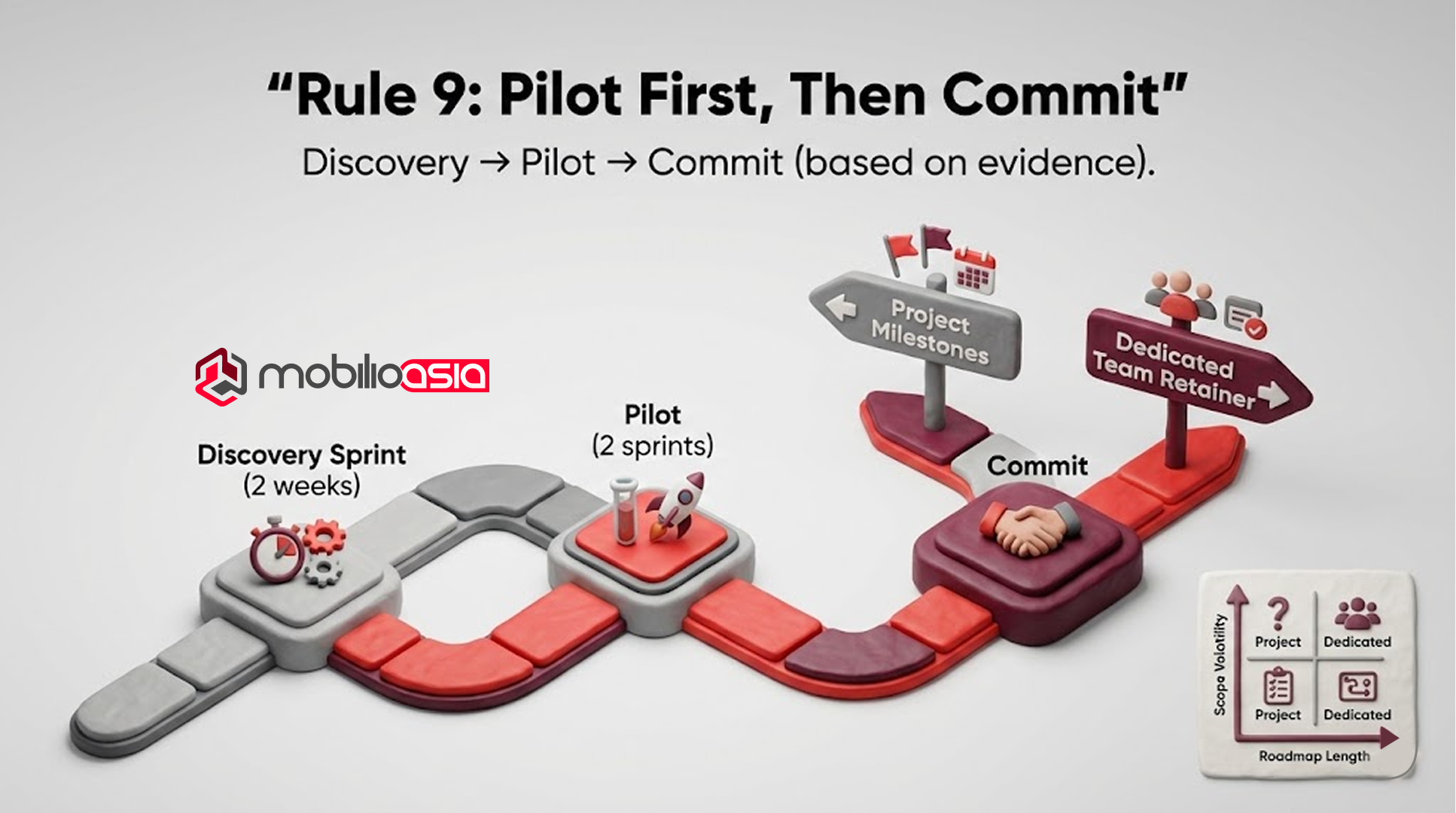
Recommended sequence:
-
Discovery sprint, often two weeks, to confirm scope boundaries, integration map, and key risks
-
Pilot delivery for two sprints to validate cadence, code quality, and collaboration
-
Commit to project milestones or a dedicated team retainer based on evidence
Add a simple decision matrix image here.

FAQ
Q1. Which model is cheaper in practice for application development outsource
For application development outsource, the project model can look cheaper upfront because you buy a fixed scope. In practice, it becomes expensive when scope changes, integrations are unclear, or acceptance criteria are weak. A dedicated team can be cheaper over a three to twelve month roadmap because it reduces rework and preserves knowledge inside one stable team.
If your roadmap is driven by measurement, align delivery reporting to outcomes. Read AI-powered Analytics: The Strategic Lever in an Uncertain Market.
Q2. Can I start with a project and transition to a dedicated team
Yes. Many teams application development outsource this way to reduce risk.
A clean sequence:
-
Discovery sprint to map scope boundaries and integrations
-
Pilot delivery to validate cadence and code quality
-
Commit to project milestones or a dedicated team based on evidence
If your product depends on mobile iteration, this transition often fits. Read Mobile-First: The Strategic Imperative for Digital Products in a Mobile-Driven Market.
Q3. How do we handle scope changes without conflict
Scope change is normal. Conflict happens when the contract does not define how change is priced, approved, and accepted.
For application development outsource, require:
-
Written scope boundaries and acceptance criteria
-
A change request workflow with time and cost impact
-
A definition of done that includes QA gates
For commercial patterns that support iterative delivery, use the external guidance on contracting for agile. See Contracting for Agile Guidance Note.
Q4. What clauses matter most for outsourcing contracts
These clauses prevent the most expensive surprises in application development outsource:
-
IP assignment and ownership
-
Repository ownership or admin access
-
Access control with least privilege
-
Security baseline expectations
-
Handover package as a deliverable
-
Termination and transition support
-
Acceptance criteria and change request mechanism
Use external references for your security baseline:
Request a proposal
If you want to application development outsource with predictable releases, ask for a proposal that includes:
-
Engagement model recommendation with rationale
-
Scope boundaries and acceptance criteria
-
Team structure and seniority mix
-
Governance cadence and decision owners
-
SLA summary and incident handling workflow
-
QA gates and release checklist
-
Security baseline aligned to NIST SSDF or OWASP SAMM
-
Handover plan and transition support
